
Language Settings
Select Website Language

Filters

Channels
Topics
Other Filters

Jaipur Civic Polls 2,644 Candidates Left After Withdrawals

After two days of name withdrawals, 2,644 candidates remain across Jaipur's 19 civic bodies. Three won unopposed. Voting falls on September 9 and 11. Rajasthan's civic body polls are trending after the nomination-withdrawal window closed. In Jaipur district, the contest is now set - here is how the field cleared and what comes next. Jaipur's field narrows to 2,644 After the withdrawal process wrapped across Jaipur district's 19 urban bodies - nagar nigam, nagar parishad and nagar palika - 2,644 candidates remain in the fight. District election officer Sandesh Nayak confirmed that these contenders will now battle it out at the ballot box on September 9 and September 11. 714 names pulled in two days Scrutiny of nomination papers had left 3,365 candidates standing across the 19 bodies. Then came the two-day withdrawal window. By its close, 714 candidates had pulled their names from the race. That exit reshaped nearly every ward, trimming the crowded field down to the 2,644 who now face voters. 218 quit statewide on day one The withdrawals were not confined to Jaipur. Statewide, more than 218 candidates stepped away from the race on the very first day of the withdrawal window alone. The final day was expected to clear the picture further, as more contenders weighed their odds and bowed out before the deadline shut. Three win before a vote Not every seat needs a ballot. Three candidates across Jaipur district were declared elected unopposed - nirvirodh - because no rival remained on the field against them. With the opposition slot empty in their wards, victory was sealed the moment withdrawals ended, well ahead of the September polling dates. Heena Banu takes Naraina In Nagar Palika Naraina's Ward 8, Congress candidate Heena Banu won without a contest. The BJP fielded no candidate against her, leaving the seat uncontested. Her unopposed victory became one of the three early wins recorded in Jaipur district before a single vote was cast in the ward. Chaksu and Manoharpur decided Two more wards were settled without polling. In Nagar Palika Chaksu's Ward 11, BJP candidate Trilok Shyam won unopposed. In Manoharpur Nagar Palika's Ward 15, Congress candidate Arjun Mohanpuria took the seat the same way. Together with Heena Banu, they complete the trio of contest-free wins. Statewide vote in two phases Polling unfolds in two rounds. The first phase on September 9 covers 164 civic bodies, while the second phase on September 11 will see voting across 145 bodies. Jaipur district's 2,644 remaining candidates are among those whose fate rests on these two September polling dates. Seven days left to campaign With the field now final, the candidates still in the running have just seven days before the first ballots are cast. First-phase voting arrives one week after the withdrawal deadline. That short window is all the time left to canvass wards and win over voters ahead of September 9. Jaipur civic body election, Rajasthan nikay chunav, nomination withdrawal, unopposed win, September 9 voting, Sandesh Nayak, municipal election 2025

Oral Drug Apixaban Prevents Blood Clots Without Needles

A study of over 3,000 patients found the oral drug Apixaban prevents deep-vein thrombosis after joint surgery and halves bleeding risk. A pill may soon replace the needle for patients at risk of dangerous blood clots after joint surgery, according to a new study published in the New England Journal of Medicine. An international research team reported that an oral anti-clotting drug called Apixaban prevents clots as well as existing injectable treatments while cutting the risk of bleeding. The finding was drawn from a double-blind trial of more than 3,000 patients. Researchers said the tablet matched the effectiveness of standard therapy at stopping clots and lowered bleeding complications by half. It was also far simpler for patients to take. The condition being targeted, deep-vein thrombosis, forms in the large veins of the lower leg and thigh. It claims hundreds of lives around the world each year and is a particular danger following joint replacement operations. If a clot breaks loose and travels through the bloodstream, it can settle in the lungs and cause pulmonary embolism, an event that is frequently deadly. Until now, the usual defence has been anti-clotting medicine delivered by syringe after surgery. Those injections are painful and carry their own risk of bleeding. The oral alternative removes the needle from the equation without adding to that risk. "This is a major step in our fight to prevent DVT and the many unnecessary deaths each year caused by blood clots after joint replacement surgery," said team leader Gary Raskob of the University of Oklahoma. Raskob added that patients now had access to a safer option. "We now have a better treatment that reduces the risk of bleeding, and a patient no longer has to endure injections by needle," he said. The research was reported from Washington. Apixaban, deep-vein thrombosis, blood clots, pulmonary embolism, joint replacement surgery, oral anti-clotting drug, New England Journal of Medicine, Gary Raskob

Bats Halt Richard Hammond's £1.99m Welsh Mansion Revamp

A wildlife survey found eight protected bat species at Richard Hammond's £1.99m Georgian estate in Wales, threatening his pavilion and padel court plans. Richard Hammond's plan to build a dream estate in Wales has run into an obstacle few buyers anticipate: a colony of legally protected bats. The former Top Gear presenter, 56, paid £1.99 million for a Georgian mansion at Llanwenarth in Monmouthshire, near Abergavenny, and now faces possible delays after a survey identified eight bat species living on the grounds. Hammond bought the 21-acre property intending to overhaul it into a personal showcase. His scheme included a pavilion, a padel court and purpose-built rooms to display his car collection. A wildlife survey has put parts of that vision in doubt. Eight bat species on the estate Surveyors working between June and August recorded eight species of bats roosting and feeding across the site. At least two of those species were seen leaving a stone barn that Hammond had earmarked for renovation, according to reports. That finding matters because British law shields bats from harm. Deliberately disturbing, injuring or killing the animals is a criminal offence, and so is wrecking or destroying the places where they roost. The rules cover their habitats as well as the creatures themselves. The government does allow licences in limited situations. One may be granted where damage or disturbance cannot be sidestepped, or where survey and conservation work is under way. Even so, Hammond may need to build accommodation for the animals into his designs, adding features such as roosting areas, purpose-made voids and bat boxes. Heritage-led defence Hammond's planning agents have stood by the proposals. They told The Times the project grew out of a heritage-led design process that responds well to the building's importance. The plans, they said, aim to protect its architectural and historic character while safeguarding its future through careful repair, restoration and adaptation. The purchase followed a difficult year in Hammond's personal life. Roughly twelve months earlier, he and Mindy Etheridge, his wife of 23 years, said they were splitting up. He has framed the new house as a fresh start, speaking warmly about finally having his vehicles under the same roof. "I moved house recently. These cars have never lived here and they're home. My babies are back. I'm childish, but I'm excited," he said. Still on the road with The Grand Tour Hammond remains tied to the motoring world on screen. The Grand Tour has entered a new era after the departure of its founding line-up of Hammond, Jeremy Clarkson and James May. Three new hosts, Francis Bourgeois, Thomas Holland and James Engelsman, are taking over the show. Bourgeois credited the outgoing trio with helping the incoming team settle in. "They've been very supportive, very warm, very open in just saying, 'Go ahead - make it your own,'" Bourgeois told The Independent. He said the fresh line-up wanted to keep enthusiasm for cars at the centre of the programme. Hammond has also talked publicly about his daughter Izzy, 25, and the worry he felt after she crashed while driving a Formula E car earlier this year. He told Metro that watching her compete can be hard given his own history in motorsport. "It's a little uncomfortable because I know from personal experience that things can and do go wrong," he said. "I'm a father, like any other father. I don't want to see my little girl hurt, but I don't want to hold her back from opportunities that present themselves." He said Izzy is forging her own path, and that he can only sit back, watch and applaud. Richard Hammond, Richard Hammond mansion, protected bats UK, Llanwenarth estate, The Grand Tour, Georgian mansion Wales, bat survey planning, Monmouthshire property

Coldcard Hacker Starts Swapping Stolen Bitcoin to Ether

A hacker behind the Coldcard wallet thefts began converting stolen Bitcoin to Ether through THORChain on September 3, Galaxy Research says. The hacker behind the third wave of Coldcard wallet thefts began converting stolen Bitcoin into Ether on September 3, using the cross-chain protocol THORChain, according to Alex Thorn of Galaxy Research. Thorn said the attacker had moved roughly 10 percent of the stolen Bitcoin at the time of his update, with the remaining 90 percent still sitting at the same address. Researchers traced the transactions to a new Ethereum address surfaced through THORChain. Thorn said he had passed that address to law enforcement, cryptocurrency companies, and other groups tracking the stolen funds. He described the activity as the first recorded on-chain movement from the original wallets tied to the first three attack waves. THORChain lets users swap native assets across blockchains without depositing funds into a centralised exchange. In this case, it allowed the hacker to turn native Bitcoin into Ether without routing the coins through a custodial platform. That structure makes the swaps harder to freeze than a transfer through a company-run exchange. Not all of the attempts worked. Thorn said the hacker appeared to run into technical trouble while trying to complete some of the swaps. He pointed to possible causes such as a fault in the system or a shortage of liquidity on the protocol, without pinning down a single reason. Where the Ether goes next remains an open question. Thorn said it would be worth watching whether the funds are pushed toward centralised exchanges, cross-chain bridges, or privacy protocols. He also noted that these THORChain swaps are separate from an earlier laundering operation carried out by different hackers. CertiK reported in August that wallets tied to that wider scheme had moved 64 BTC and 200 ETH into crypto mixing services. The 2021 firmware flaw The thefts trace back to weak randomness generation in a Coldcard firmware version released in 2021. The defect let attackers calculate users' private keys without ever touching the physical devices. That remote element set the attacks apart from the more familiar model of a breach at a centralised exchange. Coinkite, the company that makes Coldcard, says a firmware fix is now available for every affected model. Its current security guidance warns that seeds created under the flawed software still need to be migrated. Installing the update alone does not repair a seed generated under the vulnerable firmware. To be safe, Coinkite advises affected users to generate a new seed on the updated firmware and then move their Bitcoin to the new wallet address. Simply upgrading the device without creating a fresh seed leaves the underlying weakness in place. At least 15 hackers involved The scale of the exploitation goes well beyond a single actor. In a separate report in August, Thorn said at least 15 different hackers had taken advantage of the Coldcard vulnerability. He credited reports from victims with helping his firm identify new attackers who would otherwise have stayed anonymous, because the exploit worked differently from a typical exchange breach. The latest swaps mark a shift from holding to moving the stolen coins, and the disclosure of the new Ethereum address to authorities and monitoring firms is aimed at tracking the funds before they can be obscured. With the bulk of the Bitcoin still parked at the original address, further movements are likely to be watched closely. *Cryptocurrency is an unregulated digital asset, is not legal tender, and is subject to market risks. Nothing in this article constitutes financial or investment advice.* Coldcard hack, THORChain, Bitcoin to Ether swap, Coinkite firmware, crypto wallet theft, Alex Thorn Galaxy Research, crypto private keys, stolen Bitcoin

Five Twitch Records That Could Stand for Years

From Ibai's 9.3 million viewers to Kai Cenat's 1.1 million subscribers, here are five Twitch milestones that may never be beaten. Twitch has produced a handful of numbers so large they no longer resemble ordinary streaming milestones. Five records in particular stand apart: a broadcast watched by more than 9.3 million people at once, a channel with over a million paid subscribers active at the same time, and a Hype Train that climbed past level 120. Each grew out of a rare mix of huge fan communities, major online moments and, in one case, the simple unveiling of a video game outfit. What links them is not just their scale but how hard they would be to repeat. The circumstances behind each were so specific that they may sit untouched in the record books for a long time. Here is a closer look at the five, ranked by how difficult they appear to beat. Kai Cenat's 1.1 million subscribers The most striking figure belongs to Kai Cenat. During his Mafiathon 3 subathon in late September 2025, his channel reached 1,112,947 active subscribers at once. He had already broken the record during Mafiathon 2, when he passed more than 728,000. The latest run made him the first person on Twitch to cross both the 500,000 and one million marks for active paid subscribers. Holding a community that size demanded continuous production, guest appearances from well-known names and attention from around the globe. Ibai Llanos and 9.3 million viewers On July 26, 2025, Spanish creator Ibai Llanos staged La Velada del Año 5, his yearly amateur boxing show pitting online personalities and celebrities against one another. The stream passed 9.3 million peak concurrent viewers, a total that dwarfs what much of traditional television draws at a single moment. Matching it would require another event that ties mainstream sport, famous faces and internet creators together in the same way. Neuro-sama's Hype Train The highest Hype Train ever recorded on Twitch belongs to Neuro-sama, an artificial-intelligence VTuber run by British developer Vedal. During her yearly birthday subathon in early January 2026, viewers pushed the train to Level 126 at 53 percent progression, adding more than 262,793 subscribers along the way. The climb came from a rapid stream of gifted subscriptions and Bits over several hours. Reaching beyond level 120 calls for a tightly coordinated audience and a donation rate few communities can sustain. TheGrefg's Fortnite reveal On January 11, 2021, David "TheGrefg" Cánovas Martínez went live for a far simpler reason: to show off his official Fortnite Icon Series skin. The broadcast peaked at 2.47 million concurrent viewers, and parts of Twitch's API and directory briefly went down under the load. The format is what makes the figure remarkable. It was a single creator, a camera and the reveal of an in-game cosmetic. With viewers now split across many platforms, drawing close to 2.5 million people for a solo reveal looks extremely tough to achieve again. Ludwig and the month-long subathon The final record is a different kind of feat. In 2021, Ludwig Ahgren made the uncapped, month-long subathon popular, building a format in which each subscription pushed back a countdown clock while the broadcast rolled on. Creators including Ironmouse and Kai Cenat later adopted the same 30-day model, staying online while they slept, ate and talked with viewers. Stretching much past 30 or 31 straight days is a separate challenge. Twitch enforces health and safety rules covering sleep and unattended streams, and physical exhaustion sets a hard limit of its own. That turns the 30-to-31-day window into something closer to a practical ceiling than a record waiting to fall. Taken together, the five point to a pattern. Each was powered by a one-off cultural moment, an enormous community or a format that runs up against human limits. That combination is exactly why they may remain out of reach for the streamers who come next. Twitch records, Kai Cenat Mafiathon, Ibai Llanos, TheGrefg Fortnite, Neuro-sama Hype Train, Ludwig subathon, peak concurrent viewers, Twitch subscribers

Autologue Reimagines Bajaj Pulsar NS400Z as a Faired RS400

Pune's Autologue Design has revealed digital renders of a full-fairing body kit for the Bajaj Pulsar NS400Z, teasing an unofficial RS400. Pune-based Autologue Design has published digital renders of a full-fairing body kit for the Bajaj Pulsar NS400Z, offering a glimpse of a faired 400cc Pulsar that the manufacturer itself does not sell. The design house has shared the images publicly and is asking enthusiasts a single question - "Should we build it?" - to measure demand before committing to production. Bajaj launched the NS400Z in 2024 as the range-topping model in its long-running Pulsar family and has rolled out several updates since. The bike currently anchors the top of the line-up, yet buyers wanting a fully-faired machine built on its 400cc-class hardware have had nothing to choose from the factory. Autologue's concept targets exactly that gap, which is why the render reads almost like an unofficial Pulsar RS400. The company has been explicit that the project is its own independent exercise. The renders do not signal that Bajaj is working on an RS400 of its own. What the renders change The visual shift is dramatic, and most obvious head-on. Where the stock NS400Z wears a bare streetfighter face, the concept adds a broad front fairing wrapped around the headlamp, topped by a tall dark-tinted screen that lends the bike a sportbike or sports-tourer flavour. The bodywork carries down the flanks and into a deep belly pan below. Designers have layered in sharp folds, air vents and black contrast panels to build visual bulk, with bold '400' lettering placed low on the fairing. The base finish is Pearl Metallic White, paired with black and red accents that echo the production bike's colour scheme. The standard NS400Z is sold in Brooklyn Black, Glossy Racing Red and Pewter Grey. The cockpit has been reworked too. The upright handlebar of the stock machine appears swapped for a lower, more committed setup, and the handlebar-mounted mirrors give way to compact units fixed to the fairing. Should these details survive into a finished kit, they would push the riding stance and overall look in a noticeably sportier direction. Mostly stock underneath Beyond the new panels and cockpit, the renders leave the core motorcycle largely intact. The alloy wheels, tyres, golden upside-down front forks, fuel tank, split seats, grab rails, swingarm and brakes all appear carried over. One notable departure is the exhaust: the images show a more conventional side-mounted system in place of the NS400Z's factory underbelly unit. Because the concept is drawn as a bolt-on kit with no engine or chassis changes, a production version would be expected to ride and perform much like the standard bike. Earlier NS400Z units use a 373.27cc engine, while newer examples are fitted with a 350cc unit. In the market, the NS400Z lines up against the KTM 390 Duke, the Triumph Speed 400 and the Royal Enfield Guerrilla 450. A faired variant would sit apart from all of them by wrapping the same 400cc-class package in sportbike bodywork. For now the faired NS400Z exists only as a set of images. Autologue says early reaction has been encouraging and is still canvassing riders on whether to take it further. If the kit does reach production, it would hand NS400Z owners something Bajaj currently leaves off the menu - a fully-faired 400cc Pulsar. Bajaj Pulsar NS400Z, Autologue Design, Pulsar RS400, faired body kit, 400cc motorcycle, aftermarket fairing, Bajaj Pulsar, motorcycle modification

Range Rover Electric Bookings Open in India at Rs 10 Lakh Token

JLR opens Range Rover Electric bookings in India for a Rs 10 lakh token. The 118.5 kWh EV makes 550 PS, 850 Nm and a 600 km WLTP range. JLR has opened bookings for the Range Rover Electric in India, with buyers able to reserve the SUV for a token amount of Rs 10 lakh. It is the first fully electric model in the Range Rover line-up, and the company will bring it into the country as a completely built unit (CBU) imported from its Solihull plant in the United Kingdom. The launch price for India has not been announced. Estimates place the starting figure at around Rs 3.5 crore. In the United States, the Range Rover Electric is already on sale from $138,000, roughly Rs 1.30 crore. Battery, power and range The Range Rover Electric is built around a 118.5 kWh lithium-ion battery pack made up of 344 prismatic cells. It feeds two electric motors, each rated at 260 kW (354 PS), for a combined output of 405 kW (550 PS). Both motors were developed and built in-house by the company. Torque is rated at 850 Nm, the highest figure for any Range Rover to date. Measured against the ICE Range Rover fitted with the mild-hybrid 4.4-litre twin-turbo V8, the electric version produces 12 hp and 100 Nm more. It covers 0 to 96 km/h (0-60 mph) in 4.3 seconds, quicker than the 4.5 seconds recorded by the V8 model. Certified range is 600 km (372 miles) on the WLTP cycle. JLR's own EPA estimate puts real-world range at about 535 km (333 miles). The SUV uses an 800-volt electrical architecture that supports split-charging and DC fast charging of up to 350 kW. A 10 to 80 percent top-up takes 22 minutes, while a 10-minute charge adds around 220 km. Off-road hardware The electric powertrain has not replaced the model's off-road equipment. It carries twin-valve active dampers taken from the Range Rover Sport SV, along with dual-chamber air springs and rear-axle steering. Water wading capability is rated at 900 mm, helped by a setup that raises ride height automatically using sensors that track the water level. The SUV also gets a new Integrated Traction Management (ITM) system for low-grip surfaces and an Intelligent Driveline Dynamics (IDD) system. It can handle inclines of up to 33 degrees and steep climbs of up to 45 degrees. At 2,885 kg, the Range Rover Electric weighs 75 kg more than the plug-in hybrid version. Towing capacity is rated at 2.5 tonnes, below the 3.5 tonnes of the ICE model and the 3 tonnes of the PHEV. Design and cabin The exterior stays close to the fifth-generation ICE Range Rover launched in 2021. The changes are limited to a more modern grille and new alloy wheels, along with underbody revisions needed for an EV. Those tweaks cut the drag coefficient by 0.01 Cd, which the company says can add about 16 km of highway range. The Range Rover Electric is offered in standard and long-wheelbase forms. Trim levels are SE, Autobiography, SV, SV Black and SV Ultra. A First Edition option is available in Belgravia Green, Santorini Black or Varesine Blue, paired with newly introduced Light Cloud Ultrafabrics PU and Kvadrat interior. Buyers can also choose from a range of Bespoke paint colours, finishes, materials and embroidery. Inside, the layout mirrors the ICE model, with the same dashboard, steering wheel, centre console, drive mode selector and digital screens. EV-specific additions include an AI-based range predictor and a battery health monitor. Other equipment covers premium audio, a panoramic sunroof, ventilated and heated seats with a massage function, and multi-zone climate control. Range Rover Electric, JLR India, electric SUV, Range Rover EV price India, 118.5 kWh battery, 800-volt architecture, luxury EV India

Kia Sorento Hybrid Teased for India, Bookings Open

Kia India teases the Sorento Hybrid, its first hybrid SUV, and opens pre-bookings. The three-row model will rival the Toyota Fortuner and Skoda Kodiaq. Kia India has released a teaser for the all-new Sorento Hybrid, its first hybrid SUV planned for the local market, and has started taking official pre-bookings for the three-row model. The teaser marks the first look at the India-specification vehicle ahead of its launch. Once on sale, the Sorento will crown Kia India's internal-combustion SUV line-up. The company positions it against the Toyota Fortuner, Skoda Kodiaq, Volkswagen Tayron and Jeep Meridian. The teaser shows a tall, squared-off body. Up front, the SUV carries vertically arranged LED headlamps alongside T-shaped LED daytime running lights. Buyers are expected to have a choice between six-seat and seven-seat layouts. Kia has not yet shown the India-spec cabin, but the Sorento is tipped to arrive well equipped. Anticipated features include twin 12.3-inch screens serving the driver's instruments and the infotainment system, wireless Apple CarPlay and Android Auto, a panoramic sunroof, ventilated front seats, a power-adjustable driver's seat, multi-zone climate control and a 360-degree camera. Powering the India-bound model is expected to be a 1.6-litre turbocharged petrol engine working with a self-charging hybrid setup. That combination is likely to be linked to a six-speed automatic gearbox and all-wheel drive. Kia has not confirmed a launch date or pricing. Further details are expected as the debut nears Kia Sorento Hybrid, Kia India, three-row SUV, Toyota Fortuner rival, Skoda Kodiaq, hybrid SUV India, Sorento pre-booking, 1.6 turbo-petrol

2026 Tata Curvv Series X Debuts From Rs 10 Lakh

Tata's updated Curvv Series X starts at Rs 10 lakh, trims the range to six variants and loads more kit into base and mid trims. Tata Cars has rolled out a revised version of its Curvv coupe-SUV, badged the Series X, with prices opening at Rs 10 lakh (ex-showroom) for the entry Smart X trim. The update trims the range from eight variants to six, reshuffles the equipment on offer and gives every trim an "X" in its name. At the top sits the Accomplished X Plus diesel automatic at Rs 18.75 lakh. The move follows two years of the Curvv on sale in India, a period in which early buyer interest has cooled, particularly after Tata introduced its Sierra SUV. Prices have crept up marginally across the board, but Tata has offset this by handing the lower and middle trims noticeably more kit than they carried before. What has changed in the lineup The T-GDI turbo-petrol is now sold only with the automatic gearbox, its manual option having been withdrawn. From the Pure X Plus grade upwards, buyers can specify a #DARK Edition with blacked-out cabin and body panels for an extra Rs 25,000. Variants marked for the treatment sit between Pure X Plus and the flagship. The paint palette has been reworked too. Tata has retired the Gold Essence, Daytona Grey and Flame Red finishes. Five shades remain: Carbon Black, Nitro Crimson, Opera Blue, Pure Grey and Pristine White. Outwardly the car is unchanged, keeping its sloping roof, upright profile, partly closed gloss-black grille, slim LED daytime running lamps and vertically stacked headlamps. Flush door handles, thick piano-black cladding, a sharkfin antenna and a chrome window accent carry over, with alloy wheels available up to 18 inches. The base car swaps its old 16-inch wheels for 17-inch steel rims wrapped in "hyperstyle" covers as standard. Cabin and comfort tweaks Inside, the biggest addition is Oyster White leatherette upholstery, fitted from the Pure X Plus trim onward to lend a lighter feel. The layout stays familiar, with a floating infotainment screen, a digital driver's readout and touch-operated climate controls. Tata has also freed up space at the back. Reshaped front seatbacks add 10 mm of rear knee room, while the bench itself now sits 20 mm further back and 10 mm lower. Feature upgrades are concentrated in the cheaper trims, since the flagship's kit is untouched. The Pure X now brings a 10.25-inch touchscreen, wireless Android Auto and Apple CarPlay, cruise control, a six-speaker Harman Kardon system, a panoramic sunroof, automatic climate control and selectable drive modes. Step up to the mid-rung Creative X Plus and the list grows to include a 10.25-inch digital cluster, ventilated front seats, rain-sensing wipers and automatic headlamps. The range-topper piles on a powered tailgate, a six-way electric driver's seat, connected car services, an auto-dimming interior mirror and a larger 12.3-inch instrument display. Safety and engines Every Curvv Series X ships with six airbags, rear parking sensors, ISOFIX mounts, electronic stability control and hill-hold assist. The Pure X adds a reversing camera and tyre-pressure monitoring, while the Creative X Plus throws in a 360-degree camera, front parking sensors and a rear defogger. Level 2 driver-assist systems stay exclusive to the Accomplished X Plus. The Curvv holds a five-star Bharat NCAP crash rating. Three engines carry over. The 1.2-litre turbo-petrol makes 120 PS and 170 Nm, paired with a six-speed manual or seven-speed dual-clutch automatic. The 1.2-litre T-GDI unit produces 125 PS and 225 Nm, now automatic-only. The 1.5-litre diesel delivers 118 PS and 260 Nm with a choice of manual or dual-clutch automatic. In its segment the Curvv squares off most directly against the Citroen Basalt X, the other coupe-styled contender at this price. It also competes with conventionally shaped rivals including the Skoda Kushaq, Renault Duster, Kia Seltos, Volkswagen Taigun, Hyundai Creta, Maruti Grand Vitara and Victoris, Toyota Urban Cruiser Hyryder, Tata's own Sierra, Honda Elevate, Nissan Tekton and MG Astor. Tata Curvv Series X, Tata Curvv price, coupe-SUV India, Curvv Series X variants, Tata Curvv features, compact SUV India, Curvv T-GDI, Bharat NCAP

ISRO Launches GSLV-F17 With EOS-05 Imaging Satellite

ISRO's GSLV-F17 rocket lifted off before dawn from Sriharikota, placing the EOS-05 Earth observation satellite into its planned orbit. India's space agency sent its GSLV-F17 rocket skyward in a pre-dawn flight on Friday, carrying the EOS-05 Earth observation satellite into orbit. The vehicle lifted off at 2:55 am IST from the Satish Dhawan Space Centre at Sriharikota in Andhra Pradesh. Shortly after separation, EOS-05 reached the sub-geosynchronous transfer orbit planned for it. ISRO Chief Dr. V Narayanan confirmed the outcome, saying the GSLV-F17 had placed the advanced geo-imaging spacecraft precisely into its required orbit. Thomas Kurian, the mission director, called the flight a proud moment and noted it marked the GSLV programme's 19th mission. He described EOS-05 as the heaviest payload the GSLV has ever carried into a GTO or sub-GTO orbit, and said the satellite is built for near-real-time imaging. Kurian added that the few minutes of flight rested on months and years of preparation. EOS-05 is designed to keep watch over the country from an altitude of roughly 36,000 kilometres, giving India a steady overhead view of its territory. The GSLV-F17 that carried it measures 51.7 metres tall and had a liftoff mass of 420.5 tonnes, ranking it among the heaviest rockets India currently flies. Science and Technology Minister Jitendra Singh welcomed the result, saying the country's expanding space capabilities reinforce its standing as a global space power. Writing on X on September 3, 2026, he praised the ISRO team and described the mission as another major stride for India in space. Singh said EOS-05 is India's first imaging satellite operating from geosynchronous orbit. According to him, the spacecraft can capture images across the visible, infrared, multispectral and hyperspectral bands, marking a step forward in the country's remote-sensing abilities. ISRO, GSLV-F17, EOS-05, Earth observation satellite, Sriharikota, V Narayanan, Jitendra Singh, Satish Dhawan Space Centre

Smriti Mandhana Smashes 124 to Break Women's Century Record

Smriti Mandhana hit 124 off 64 balls against Hong Kong, claiming an 18th international century to pass Meg Lanning's record as India posted 193/5 in Dubai. Smriti Mandhana blasted 124 off 64 balls to become the leading century-maker in women's international cricket as India Women posted 193 for 5 against Hong Kong in their Women's Asia Cup 2026 match in Dubai on Thursday. The innings was Mandhana's 18th international century, taking her past former Australia captain Meg Lanning, who holds 17. South Africa's Laura Wolvaardt also has 17, while West Indies' Hayley Matthews has 15. Mandhana struck 14 fours and seven sixes at a strike rate of 193.75. Hong Kong won the toss and asked India to bat first. Mandhana and Shafali Verma gave the innings a rapid start, putting the bowlers under pressure from the outset. Verma made 28 off 17 balls before falling, a wicket that briefly brought Hong Kong back into the contest. Mandhana pressed on as batters fell around her. She reached her half-century off 40 balls, then accelerated sharply, moving from 50 to 100 in only 17 deliveries. Her century came up in 57 balls, and she kept attacking until the last ball of the innings. The knock set a new mark for the highest individual score in Women's T20 Asia Cup history. It surpassed the 119 by Sri Lanka's Chamari Athapaththu against Malaysia in Dambulla in 2024. Mithali Raj's unbeaten 97 against Malaysia in Kuala Lumpur in 2018 sits third on the list, followed by Sri Lanka's Harshitha Samarawickrama and India's Shafali Verma, both on 81. Mandhana's stay ended in the final over. After Bharti Fulmali steered a yorker towards point, Mandhana went for a single but had little chance. Iqra Sahar's direct throw to the striker's end found her well short, ending the innings on a flat note. Her 124 made up close to two-thirds of India's total and left Hong Kong chasing 194 to win. Around her, Richa Ghosh made 11, Harmanpreet Kaur 10 and Deepti Sharma an unbeaten 1. For Hong Kong, Marina Lamplough was the pick of the bowlers with 2 for 46. Joyleen Kaur, Ruchitha Venkatesh and Iqra Sahar each took a wicket. Smriti Mandhana, Women's Asia Cup 2026, India Women cricket, Meg Lanning record, Shafali Verma, women's cricket century, India vs Hong Kong, T20 Asia Cup record

8th Pay Commission: 7% Increment Could Add Rs 28.89 Lakh

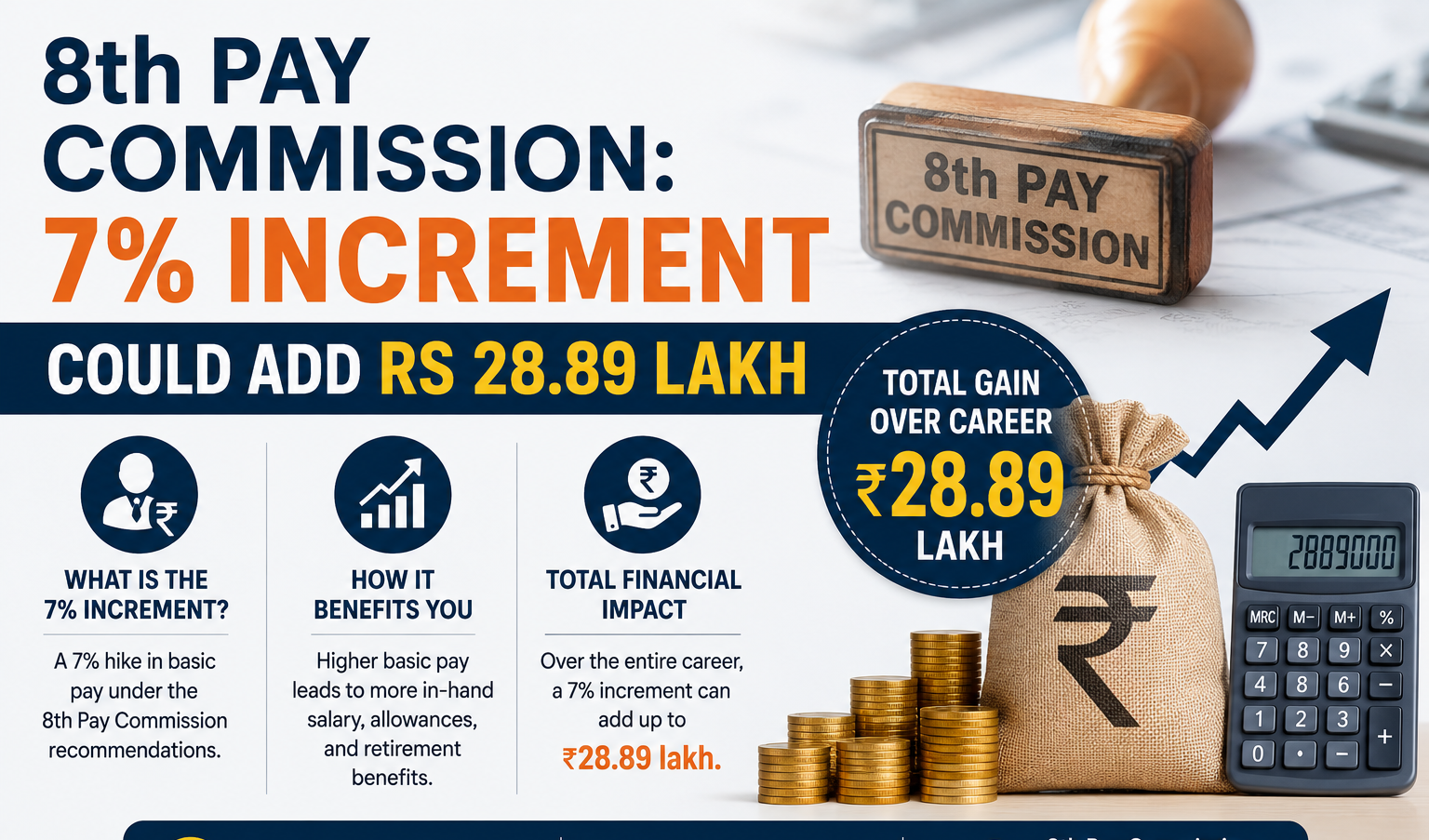
Central government employee unions want the annual increment raised from 3% to as high as 7%. For a Level 8 staffer, that could mean Rs 28.89 lakh more over a decade. The 8th Pay Commission will hold consultations in Chennai on September 7 and 8, where representatives of employee and pensioner organisations plan to press their case for a higher annual increment for central government staff. The Chennai sessions follow a two-day round of stakeholder meetings held in Jaipur. At the centre of the discussions is the yearly increment rate. Staff bodies want it lifted from the present 3%, arguing that the figure has failed to keep up with the cost of living. The demands placed before the commission span 5% to 7%, and any increase would reshape how a government salary grows across the life of a pay commission. What the unions are asking for The National Council of the Joint Consultative Machinery, the principal forum for central government workers, has asked for 6% in the memorandum it submitted to the commission. The All India Defence Employees' Federation and the Federation of National Postal Organisations have put forward the same 6% figure. The steepest demand comes from the All India New Pension Scheme Employees' Federation, which wants 7%. The Indian Railways' Supervisors' Association has taken the most modest position among these groups, seeking 5%. Employee associations say the gap is felt hardest by staff at the lower pay levels, especially those posted in Tier I cities, where a basic salary stretched by only 3% growth leaves little room after everyday costs. The AINPSEF has claimed that a 7% rate could bring an employee's basic pay close to double over a single pay commission. How 3% plays out today The effect of the current rate is easy to trace at the bottom of the pay matrix. A Level 1 employee starts on a basic pay of Rs 18,000 under the 7th Pay Commission. Compounded at 3% a year, that basic reaches roughly Rs 23,500 by the end of the commission's tenth year. The pattern repeats higher up. A Level 5 employee begins at Rs 29,200 and, at the same rate, arrives at about Rs 38,100 in the tenth year. Basic pay is only part of the packet, since most employees also draw dearness allowance, house rent allowance and transport allowance on top of it. The Level 8 example To show what a steeper rate would deliver, the calculation takes a Level 8 employee whose basic pay now stands at Rs 47,600. It assumes the 8th Pay Commission settles on a fitment factor of 2.15, which lifts the basic to an estimated Rs 1,02,340. From there, the figures are projected over ten years at 3%, 5% and 7%. In the first year every scenario looks identical: a monthly basic of Rs 1,02,340 and an annual salary of Rs 12,28,080. The paths separate over time. By year ten, the 3% track yields a monthly basic of Rs 1,33,530 and an annual figure of Rs 16,02,366. Switch to 5%, and the tenth-year monthly basic climbs to Rs 1,58,763, taking the annual salary to Rs 19,05,155. Across the full decade, total pay under 3% works out to Rs 1,40,78,561, against Rs 1,54,46,658 under 5% - a difference of Rs 13,68,097 in the employee's favour. The 7% scenario stretches the gap much further. In year ten the monthly basic reaches Rs 1,88,148 and the annual salary Rs 22,57,775. Summed over ten years, the total comes to Rs 1,69,67,703, compared with the same Rs 1,40,78,561 under 3%. That leaves an extra Rs 28,89,143 over the decade. The comparison underlines how even a couple of percentage points on the annual increment compound into a wide spread in take-home pay over the years. The numbers remain projections. The rate that is finally applied, and the shape of the wider salary revision, will only be confirmed once the government formally notifies the 8th Pay Commission report. 8th Pay Commission, annual increment rate, central government employees, NC-JCM, fitment factor, Level 8 basic pay, AINPSEF, salary revision

PSG look for their first Ligue 1 win against Monaco

PSG have still not won a Ligue 1 match this season. After two games, the European champions have recorded two draws. The exact opposite is true of Monaco, who, with two wins from two games, are one of the teams in form at the start of the season. The two Ligue 1 heavyweights will meet on Friday in Paris.

Ariana Grande's Tearful O2 Farewell as She Steps Back

Ariana Grande closed her Eternal Sunshine tour at London's O2 Arena in tears, wrapping up before a planned step back from public life. Ariana Grande has closed the curtain on her Eternal Sunshine tour and, with it, her public life for the foreseeable future. Here's how the singer's emotional final night in London unfolded. Farewell at The O2 On Tuesday night at London's O2 Arena, Ariana Grande brought her Eternal Sunshine tour to a close, blinking back tears as she readied herself to disappear from public view. The show became a farewell in every sense, with the singer signalling this may be her last stage appearance for a long time. A Tearful One Last Time Her composure cracked most during One Last Time, the ballad that grew into an anthem for survivors of the 2017 Manchester bombing. Sinking to her knees to reach the front rows, she leaned on the audience for strength: 'London, I'm going to need you to help me on this one,' she told them. The Step Back Explained The concert followed a decision revealed a month earlier: Grande said she would withdraw from all forthcoming public-facing work. Her publicist framed it as a 'step back from visibility,' pointing to what was described as 'endless, ongoing public scrutiny' surrounding the singer's health and appearance in recent months. Barbican Show Abandoned The retreat forced her out of a planned run in Stephen Sondheim's Sunday in the Park with George at London's Barbican next summer. She had been set to star opposite her Wicked colleague Jonathan Bailey - who, on the same Tuesday, announced he too was leaving the production behind. Stilettos Swapped for Boots A foot injury reshaped her look for the night, forcing her to trade her signature stilettos for a series of knee-high platform boots. Undeterred, she darted across the stage in lockstep with her dancers, frequently rising onto tip-toe to make up for the height her heels would have given her. A Wobble on Nowhere, Nobody Her voice wavered a second time on Nowhere, Nobody, catching on the lyric 'Hard to believe in a perfect ending.' The wobble passed quickly. Grande steadied herself and carried on, staying commanding throughout despite showing no other hint of the frailty fans had recently feared. Gratitude to the Crowd Near the finish, Grande turned to her audience with gratitude. 'This has been one of the most beautiful extraordinary experiences of my life,' she said, adding that she wanted to voice her thanks 'without sobbing completely.' She called them the finest fans in the world and promised to treasure the memory always. Petal Video and Pushback Speculation had spiked after the video for her single Petal appeared, with one X user calling the 33-year-old alarmingly thin. Days later in Chicago, Grande pushed back, insisting the decision sprang from a 'thoughtful, empowered place' set in motion 'a long time ago.' 'Boundaries need to be set,' she reminded the crowd. Ariana Grande, Eternal Sunshine tour, O2 Arena London, Ariana Grande hiatus, One Last Time, Jonathan Bailey, Ariana Grande farewell, Ariana Grande Petal

Google Trends Adds Category Filters to Explore Page

Google Trends now lets users filter the Explore page by pre-defined categories without typing a query, helping refine and narrow search trend data. Google has added category filters to Google Trends, allowing users to sort the Explore page by pre-defined categories without first entering a search query. Google announced the change on LinkedIn. The update means people can now browse trend data for a specific category on its own. Previously, seeing data on the Explore page required typing in a query. With the new filters, a category can serve as the starting point instead. The categories also work alongside a search term. Users can apply a category to a query to keep the results confined to that topic. Google said this helps ensure a query stays within a chosen category and does not overlap with other categories of searches. That overlap control is one of the more practical uses of the feature. When a search term could sit across several subjects, the category filter narrows the data down and strips out results that belong to unrelated areas. The filters can also help with idea generation. Anyone hunting for fresh topics to cover within a particular category can use the tool to surface what is trending in that space. The feature is live now on the Google Trends Explore page. Google Trends, category filters, Google Trends Explore, search trends, SEO tools, keyword research, Google search data