Bikaner, Sonipat and Rohtak feature in a November 4 pollution ranking as Delhi's CPCB AQI reaches 373 amid worsening air quality.
Bikaner, Sonipat and Rohtak feature among the worst-affected cities in a November 4 real-time pollution snapshot, raising fresh concerns over northern India's deteriorating air quality.
India's air pollution crisis has drawn renewed attention after a real-time global pollution ranking published on November 4, 2026, reportedly placed 25 Indian cities among the world's most polluted locations.
The reported figures highlight the growing pollution problem across Rajasthan, Haryana, Uttar Pradesh, Punjab and the National Capital Region (NCR).
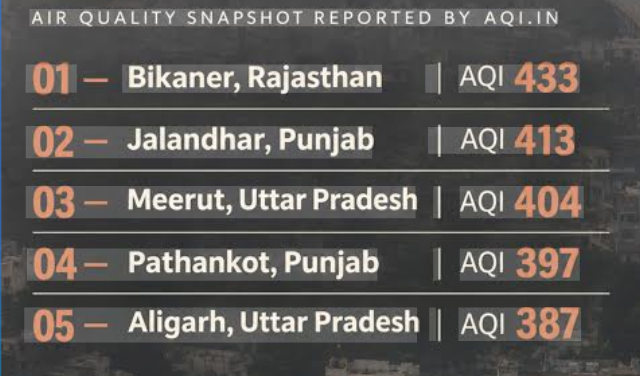
According to the reported third-party ranking, Bikaner in Rajasthan recorded an Air Quality Index (AQI) of 732, placing it at the top of the list. Sonipat in Haryana followed with 668, while Rohtak recorded 654.
Other cities featuring prominently included Ghaziabad (560), Greater Noida (553), Hisar (552), Moradabad (551), New Delhi (546) and Noida (519).
The ranking reportedly classified all 25 cities under its hazardous pollution category. However, these are third-party real-time readings and should not be confused with official CPCB measurements.
Northern India emerges as a major pollution hotspot
The reported pollution levels indicate that the crisis extends well beyond Delhi.
Several cities across the northern states are experiencing deteriorating air quality, with urban emissions, industrial activity, road dust and seasonal weather conditions contributing to the problem.
The concentration of highly polluted cities across multiple states also highlights the need for coordinated pollution-control measures rather than focusing exclusively on the national capital.
Air pollution does not respect administrative boundaries, and pollutants can travel between neighbouring regions depending on wind direction and atmospheric conditions.
Delhi's official AQI reaches 373
Meanwhile, Delhi's official air quality remained in the very poor category on the morning of November 4.
According to Central Pollution Control Board (CPCB) data reported by Business Standard, the city's overall AQI reached 373 at around 7 AM, compared with 331 on Tuesday.
Of the 59 reporting monitoring stations, 54 recorded readings above 300, while 21 stations crossed the 400 mark, entering the severe category under India's national AQI classification.
These figures demonstrate the widespread nature of the pollution episode across the capital.
The difference between Delhi's official CPCB reading and the much higher figures reported by some private air-quality platforms is partly attributable to differences in AQI scales, measurement methods and reporting times.
Why are AQI readings above 500 being reported?
India's official National Air Quality Index uses six categories:
| AQI range |
CPCB classification |
| 0–50 |
Good |
| 51–100 |
Satisfactory |
| 101–200 |
Moderate |
| 201–300 |
Poor |
| 301–400 |
Very Poor |
| 401–500 |
Severe |
The official CPCB scale ends at 500.
Some international and private air-quality platforms use different AQI systems, including the US AQI scale, which can produce readings above 500.
Therefore, a reported reading of 732 should be understood in the context of the platform's measurement system rather than treated as an official CPCB AQI figure.
This distinction is important when comparing pollution levels between cities and countries.
GRAP restrictions in Delhi-NCR
As pollution levels worsened, authorities continued pollution-control measures under the Graded Response Action Plan (GRAP).
Stage II measures were reported to be in force across Delhi-NCR from November 2.
These measures include enhanced road cleaning, water sprinkling to control dust, restrictions on certain polluting activities, improved public transport measures and tighter enforcement against pollution sources.
The Commission for Air Quality Management (CAQM) coordinates the implementation of these measures across the National Capital Region and adjoining areas.
The effectiveness of these restrictions depends on implementation, monitoring and cooperation between local authorities and residents.
What is causing the worsening pollution?
Experts identify several contributing factors behind northern India's seasonal air pollution problem.
Vehicular emissions: Cars, buses, trucks and two-wheelers release pollutants that contribute to poor urban air quality.
Industrial emissions: Factories, power generation and other industrial activities can release particulate matter and harmful gases.
Construction dust: Building projects, road construction and uncovered materials contribute to airborne dust.
Crop-residue burning: Agricultural fires in parts of Punjab, Haryana and neighbouring states can add smoke and particulate pollution to the regional atmosphere.
Unfavourable weather: Falling temperatures, weak winds and atmospheric conditions that limit the dispersion of pollutants can cause pollution to accumulate near ground level.
The combined impact of these factors can produce severe pollution episodes, particularly during the winter season.
PM2.5: The invisible threat to human health
One of the most concerning components of air pollution is fine particulate matter known as PM2.5.
These particles are extremely small and can penetrate deep into the lungs. Some can enter the bloodstream and contribute to serious health problems.
Long-term exposure to PM2.5 is associated with an increased risk of respiratory illnesses, cardiovascular diseases and other health complications.
Children, older adults, pregnant women and people with existing heart or lung conditions are particularly vulnerable.
The World Health Organization has repeatedly highlighted the health risks associated with exposure to fine particulate matter.
What can people do to reduce exposure?
During periods of severe pollution, residents should take practical precautions:
-
Check local air-quality updates before outdoor activities.
-
Avoid strenuous outdoor exercise when pollution levels are high.
-
Consider a well-fitting N95 or equivalent respirator when exposure cannot be avoided.
-
Keep windows closed when outdoor pollution is particularly high, while maintaining appropriate indoor ventilation and filtration.
-
Use an effective indoor air purifier where available.
-
Follow health advice, especially for children, older adults and people with respiratory or cardiovascular conditions.
Anyone experiencing significant breathing difficulty or chest discomfort should seek medical attention.
A growing environmental challenge for India
The November 4 pollution snapshot highlights the scale of India's air-quality challenge, particularly across northern states.
Although real-time rankings fluctuate and different monitoring platforms use different measurement systems, the independently reported CPCB readings in Delhi confirm that the region is experiencing serious air-quality problems.
Addressing the crisis requires sustained action on transport emissions, industrial pollution, construction dust, agricultural burning and urban waste management.
Cleaner air is not simply an environmental objective. It is a public-health necessity and an important requirement for India's long-term economic and social development.
By News National Editorial Team
Sources and references
-
-
-
-
-
-
-