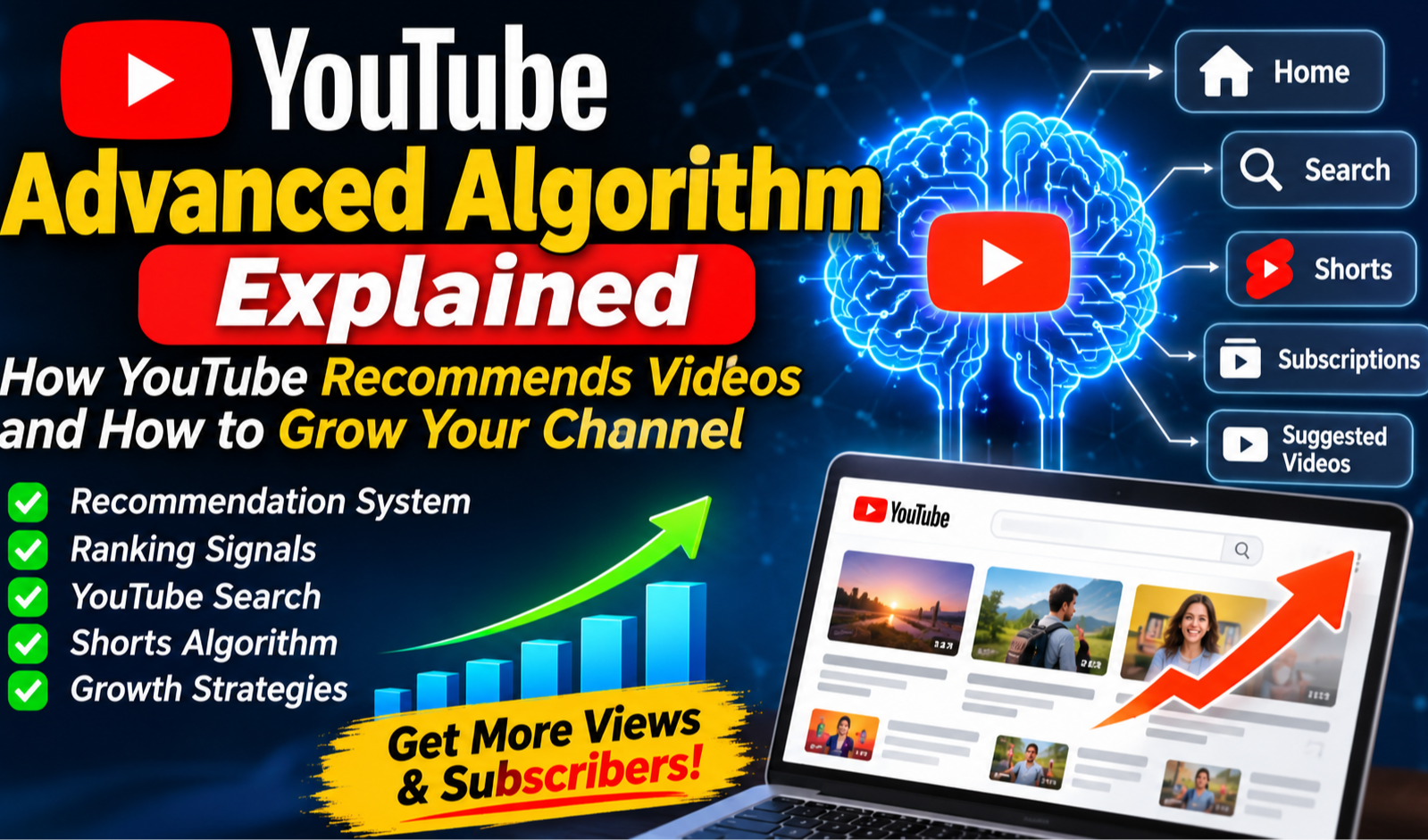
Learn how the YouTube algorithm works in 2026-2027, including AI recommendations, video ranking, watch time, CTR, audience retention, Shorts, YouTube SEO, and channel growth strategies.
Introduction
YouTube has become one of the world's largest video-sharing platforms, with millions of creators publishing videos across different categories every day. From educational tutorials and technology reviews to entertainment, gaming, news, and short-form videos, the platform provides content for audiences with different interests.
However, one important question concerns almost every creator: How does YouTube decide which videos appear on the homepage, in search results, in suggested videos, and in the Shorts feed?
The answer lies in YouTube's recommendation and discovery systems.
The YouTube algorithm is not a single ranking formula. It is a collection of sophisticated machine-learning and recommendation systems designed to connect individual viewers with videos they are likely to watch and enjoy.
Understanding these systems can help creators make better content decisions, improve audience engagement, increase organic reach, and build sustainable YouTube channels.
This comprehensive guide explains how the YouTube algorithm works, its major ranking and recommendation signals, how artificial intelligence supports video discovery, and what creators can do to improve their chances of reaching the right audience.
1. What Is the YouTube Algorithm?
The YouTube algorithm refers to the automated systems that help organize, recommend, and rank videos across the platform.
Its primary purpose is to identify content that is relevant and valuable to each individual viewer.
For example, imagine three people using YouTube:
-
Person A regularly watches technology tutorials.
-
Person B enjoys cricket highlights and sports analysis.
-
Person C watches Telugu movies, entertainment, and news.
Even when all three users open YouTube at the same time, their homepages can display completely different videos.
This happens because YouTube personalizes recommendations based on individual viewing behavior, interests, and other available signals.
According to YouTube's official explanation, its recommendation system uses signals such as watch history, search history, subscriptions, likes, dislikes, and viewer feedback.
2. How the YouTube Recommendation System Works
YouTube recommendations appear in several important areas.
YouTube Home Page
The homepage displays a personalized selection of videos based largely on a viewer's watch history and interests.
Suggested Videos
Suggested videos appear alongside the video someone is watching or as recommendations for what to watch next.
YouTube Search
Search results help viewers find videos relevant to their queries.
YouTube Shorts Feed
The Shorts feed provides personalized vertical videos based on viewer interests and interactions.
Subscription Feed
The subscription feed helps viewers discover newly published videos from channels they follow.
Each surface has different purposes and can use different combinations of recommendation signals.
3. How YouTube Uses Artificial Intelligence and Machine Learning
Artificial intelligence and machine learning are important parts of modern recommendation systems.
YouTube uses these technologies to understand viewer preferences, identify relevant videos, and estimate which content a person may enjoy.
A simplified explanation of the process includes the following stages:
Stage 1: Viewer Behavior Analysis
The system learns from available information such as videos watched, searches, subscriptions, and feedback.
Stage 2: Video Discovery
The system identifies videos that could be relevant to a particular viewer.
Stage 3: Interest Prediction
Machine-learning models estimate how likely someone is to choose and enjoy different videos.
Stage 4: Recommendation Ranking
Potential videos are evaluated and organized for a particular recommendation surface.
Stage 5: Continuous Learning
New viewing behavior and feedback help improve future recommendations.
This is a simplified conceptual explanation, not a disclosure of YouTube's proprietary internal architecture.
4. Seven Important Signals That Influence YouTube Recommendations
YouTube considers multiple signals to understand whether a video is suitable for a particular viewer.
4.1 Click-Through Rate (CTR)
Click-through rate measures the percentage of impressions that result in clicks.
For example, if YouTube displays a video's thumbnail 10,000 times and 500 people click it, the CTR is 5%.
Formula:
\[ CTR = \frac{\text{Clicks}}{\text{Impressions}}\times100 \]
Creators can improve their thumbnail and title strategy by:
-
Using clear and attractive thumbnails.
-
Creating titles that communicate the video's value.
-
Avoiding misleading or exaggerated headlines.
-
Making the thumbnail relevant to the actual content.
A high CTR does not guarantee more recommendations. YouTube also considers what viewers do after clicking.
4.2 Watch Time
Watch time refers to the total amount of time viewers spend watching videos.
For example, if 100 viewers each watch a video for five minutes, the total watch time is 500 minutes.
Watch time helps YouTube understand how viewers interact with content. However, longer videos do not automatically perform better than shorter videos.
The important objective is to deliver content that viewers genuinely want to watch.
4.3 Audience Retention
Audience retention measures how much of a video viewers continue watching.
Suppose a video is 10 minutes long and the average viewer watches five minutes.
The average percentage viewed is 50%.
Creators should study retention graphs to identify:
-
Where viewers stop watching.
-
Which sections maintain attention.
-
Whether introductions are too long.
-
Whether the content matches the title and thumbnail.
-
Which sections viewers replay.
Improving audience retention can help create a more satisfying viewing experience.
4.4 Viewer Satisfaction
Viewer satisfaction is an important part of YouTube's recommendation philosophy.
A video may receive many clicks and substantial watch time, but those numbers alone do not necessarily mean viewers enjoyed it.
YouTube uses feedback, including satisfaction surveys, alongside other signals to better understand the value viewers receive from watching content.
4.5 Likes, Dislikes, Comments, and Shares
Viewer interactions provide additional information about content performance.
-
Likes indicate positive feedback.
-
Dislikes help identify content viewers may not enjoy.
-
Comments show audience participation.
-
Shares can indicate that viewers find content worth recommending to others.
These interactions should be viewed as supporting signals rather than guaranteed ranking factors with fixed weights.
4.6 Search and Watch History
YouTube uses available viewing and search history to personalize recommendations.
For example, if someone frequently watches smartphone reviews, YouTube may recommend new smartphone comparisons, product tutorials, or technology-related videos.
4.7 Viewer Feedback
Actions such as selecting "Not interested" or "Don't recommend channel" help YouTube understand which content a viewer wants to avoid.
These controls contribute to personalized recommendations.
5. Understanding YouTube's Video Ranking Process
One of the biggest misunderstandings among creators is the belief that YouTube distributes every uploaded video to all subscribers and then decides whether it deserves more views.
In reality, YouTube's discovery systems aim to find appropriate videos for individual audiences.
A simplified video ranking process looks like this:
Step 1: Content Identification
YouTube processes video information, including its title, description, audio, visual content, and other contextual information.
Step 2: Audience Matching
The system identifies viewers who may be interested in the video's subject.
Step 3: Candidate Selection
Potentially relevant videos are selected for consideration.
Step 4: Performance Evaluation
The system considers how similar viewers respond when videos are presented to them.
Step 5: Personalized Ranking
Videos are ranked according to their relevance and predicted value for an individual viewer.
Step 6: Recommendation Updates
As viewers interact with videos, their future recommendations can change.
Importantly, YouTube does not publish a universal scoring formula or guarantee that a video will pass through these exact stages in this order.
6. How the YouTube Shorts Algorithm Works
YouTube Shorts has a different viewing environment from traditional long-form videos.
Viewers typically scroll through a continuous vertical feed, deciding within seconds whether to continue watching or move to another video.
Important Shorts performance metrics include:
Viewed vs Swiped Away: Measures whether viewers choose to watch a Short or swipe past it.
Engaged Views: Helps measure Shorts views where viewers stay beyond the initial seconds.
Average View Duration: Shows how long viewers watch a Short on average.
Average Percentage Viewed: Measures how much of the video viewers watch.
Likes and Shares: Provide additional information about audience interaction.
How to Improve Shorts Performance
-
Start with an interesting opening.
-
Avoid unnecessary introductions.
-
Deliver the main information quickly.
-
Use clear visuals and understandable audio.
-
Maintain a consistent storytelling structure.
-
Make the ending meaningful.
-
Publish content that matches your target audience's interests.
A successful Short should provide value rather than simply trying to force viewers to watch until the end.
7. How YouTube Search Ranking Works
YouTube Search is another important discovery system.
When someone searches for a topic, YouTube attempts to display videos that are relevant and useful for that particular query.
For example, someone searches for:
"How to start a YouTube channel in 2026"
YouTube considers factors such as:
-
Relevance of the video to the search query.
-
Keywords and context in the title and description.
-
-
Engagement with relevant search results.
-
Viewer satisfaction and other quality signals.
Search results are not simply arranged according to total views. A smaller channel can rank for a relevant search query if its video provides a better result for that viewer.
YouTube SEO Best Practices
-
Research keywords before creating videos.
-
Write descriptive and relevant titles.
-
Create informative descriptions.
-
Include relevant keywords naturally.
-
Use accurate video chapters.
-
Design thumbnails that clearly represent the content.
-
Answer the viewer's search intent.
Avoid keyword stuffing, misleading titles, and unrelated tags.
8. The Importance of Niche and Audience Targeting
A YouTube channel's niche helps viewers understand what type of content they can expect.
For example, a channel focusing on digital marketing might publish videos about:
-
Search engine optimization.
-
-
-
-
-
When videos serve a reasonably consistent audience, it becomes easier to understand who the content is intended for and create related topics that viewers may enjoy.
However, creators should not assume that YouTube requires every channel to cover only one topic. Different topics can succeed when they serve overlapping audience interests.
9. How to Optimize Videos for the YouTube Algorithm
Creators should focus on improving the entire viewing experience, from discovering a video to finishing it.
|
Optimization area
|
Recommended approach
|
|
Topic
|
Choose subjects your audience wants
|
|
Title
|
Make the topic clear and compelling
|
|
Thumbnail
|
Use attractive and accurate visuals
|
|
Introduction
|
Explain the value immediately
|
|
Content
|
Provide useful and original information
|
|
Audio
|
Maintain clear sound quality
|
|
Editing
|
Remove unnecessary sections
|
|
Ending
|
Recommend a relevant next video
|
|
Analytics
|
Study performance and improve future uploads
|
The objective is not to trick the algorithm. It is to create content that viewers genuinely appreciate.
10. Understanding YouTube Analytics
YouTube Studio provides valuable information about how videos perform.
The most useful reports include:
Impressions: How often eligible video thumbnails are shown through counted YouTube impression surfaces.
Impressions Click-Through Rate: The percentage of counted impressions that result in views.
Views: The number of views received.
Watch Time: Total time viewers spend watching.
Average View Duration: Average time spent watching a video.
Audience Retention: Shows how viewers remain engaged throughout the video.
Traffic Sources: Identifies where viewers discover content, such as YouTube Search, Browse Features, Suggested Videos, and external sources.
Returning Viewers: Helps creators understand whether viewers come back to watch more content.
Example: Analyzing Video Performance
Imagine a creator publishes a 10-minute educational video.
|
Metric
|
Example result
|
|
Impressions
|
20,000
|
|
Views from impressions
|
1,200
|
|
CTR
|
6%
|
|
Average view duration
|
4 minutes 30 seconds
|
|
Average percentage viewed
|
45%
|
These figures can help the creator investigate thumbnail performance, audience retention, and content quality.
They are illustrative figures, not official performance benchmarks.
11. Common YouTube Algorithm Myths
Many creators follow outdated advice about how YouTube works. Understanding the difference between myths and facts can prevent wasted effort.
|
Myth
|
Reality
|
|
Uploading daily guarantees growth
|
Content quality and viewer interest matter
|
|
More subscribers guarantee more views
|
Recommendations are personalized
|
|
Every video must go viral
|
Consistent audience development is valuable
|
|
Longer videos always rank higher
|
Video length should match viewer needs
|
|
Tags are the most important SEO factor
|
Relevance and viewer response matter more
|
|
High CTR guarantees viral success
|
Viewers must also find the content satisfying
|
|
One unsuccessful video destroys a channel
|
A single video does not automatically ruin channel performance
|
|
Uploading at a fixed time guarantees views
|
There is no universal best publishing time
|
YouTube's official creator guidance emphasizes audience interests, video performance, and viewer satisfaction rather than secret tricks or guaranteed formulas.
12. Advanced Strategies for Growing a YouTube Channel
Creators who want sustainable growth should develop a complete content strategy.
12.1 Research Audience Demand
Before producing a video, identify what your potential audience wants to learn, watch, or understand.
Useful research methods include:
-
YouTube Search suggestions.
-
Competitor channel analysis.
-
-
-
-
Frequently asked questions within your niche.
12.2 Build Topic Clusters
Instead of publishing unrelated videos, create connected groups of content.
For example, a technology channel could develop a smartphone topic cluster:
-
Best smartphones in 2026.
-
Smartphone camera comparison.
-
-
Smartphone battery optimization.
-
Best smartphones for gaming.
These videos can help viewers discover additional relevant content.
12.3 Improve the First 30 Seconds
The beginning of a video is an opportunity to establish why someone should continue watching.
A good introduction should:
-
-
Identify the viewer's problem.
-
Communicate what the video will deliver.
-
Avoid unnecessary introductions.
12.4 Use Playlists Strategically
Organize related videos into playlists.
Examples include:
-
-
YouTube Growth Strategies.
-
-
Digital Marketing Training.
Playlists help viewers navigate related content, although simply creating playlists does not guarantee higher rankings.
12.5 Create a Consistent Publishing Strategy
Consistency helps creators maintain an organized production schedule.
However, publishing frequency should be realistic. It is better to produce valuable videos consistently than to publish low-quality content every day.
12.6 Analyze Competitors
Study successful channels in your niche.
Look at:
-
-
Video presentation styles.
-
-
-
-
Use competitor research to discover opportunities, not to copy another creator's work.
13. The Role of Content Quality and Authority
YouTube recommendations are not based only on engagement.
For subjects involving news, health, science, and other sensitive information areas, information quality and authoritative sources can also matter.
YouTube has described systems designed to reduce recommendations of harmful misinformation and borderline content.
This is particularly important for creators producing news and educational content. Accurate information, reliable references, transparent presentation, and responsible reporting help establish audience trust.
14. The Future of the YouTube Algorithm
Artificial intelligence will continue to influence how people discover and consume videos.
Some important developments shaping the future of video recommendations include:
AI-Powered Personalization: Recommendation systems can become better at understanding individual interests and viewing preferences.
Multimodal Video Understanding: AI can analyze different aspects of video content, including text, audio, and visual information.
Improved Search Understanding: Search systems can better understand natural-language questions and the meaning behind queries.
Personalized Shorts Discovery: Short-form video recommendations can become increasingly tailored to individual viewing patterns.
Viewer Satisfaction Measurement: Platforms can continue developing ways to understand whether viewers find content genuinely useful and enjoyable.
These are technology trends and possible developments, not a guarantee of specific future YouTube features.
15. Practical YouTube Algorithm Growth Checklist
Creators can use the following checklist before and after publishing a video.
-
Select a topic relevant to the target audience.
-
Research the subject and competing videos.
-
Create an accurate, compelling title.
-
Design an attractive thumbnail.
-
Write a useful video description.
-
Make the opening engaging.
-
Deliver the promised information.
-
Maintain good audio and video quality.
-
Add relevant chapters where useful.
-
Organize related videos into playlists.
-
Review impressions and CTR.
-
Study audience retention.
-
-
Improve future videos using analytics.
16. Frequently Asked Questions (FAQs)
Q1. How does the YouTube algorithm decide which videos go viral?
YouTube does not have a specific viral-video formula. Its recommendation systems identify videos that may interest individual viewers and consider their responses, including whether they watch and enjoy the content.
Q2. Does YouTube promote videos from new channels?
Yes. New channels can reach audiences through Search, Home, Suggested Videos, and Shorts. Having a large subscriber base is not a requirement for every recommendation opportunity.
Q3. Does watch time affect YouTube rankings?
Watch time is an important signal, but it is not the only factor. Viewer satisfaction, relevance, personalization, and other signals also contribute.
Q4. Is CTR important for YouTube growth?
Yes. CTR helps creators understand how effectively thumbnails and titles attract clicks from counted impressions. However, CTR should be evaluated alongside retention and viewer satisfaction.
Q5. How does the YouTube Shorts algorithm work?
The Shorts recommendation system personalizes the feed using viewer interests and behavior. Metrics such as viewed versus swiped away, engaged views, average view duration, and viewer interactions can help creators understand performance.
Q6. Can a video with fewer views get recommended?
Yes. YouTube recommendations are personalized, so a video with relatively few total views may still be relevant to a particular viewer.
Q7. How often should I upload videos?
There is no universal publishing frequency that guarantees growth. Choose a schedule that allows you to maintain content quality and consistency.
Q8. Do YouTube tags help videos rank?
Tags can help provide additional context, particularly for common misspellings, but they play a relatively small role in video discovery compared with more important factors such as relevance and viewer response.
Q9. Does deleting an unsuccessful video improve channel performance?
Deleting videos is not a guaranteed growth strategy. Review the video's performance first and understand why it did not meet your expectations.
Q10. What is the most important factor in the YouTube algorithm?
There is no single universally most important factor. YouTube tries to match each viewer with relevant and satisfying content using multiple signals.
Conclusion
The YouTube algorithm is a sophisticated recommendation system designed to connect viewers with videos that match their interests and provide value.
Understanding how personalization, machine learning, watch time, audience retention, CTR, viewer satisfaction, and video relevance work together can help creators make smarter decisions.
However, there is no guaranteed formula for going viral or ranking every video.
The most sustainable YouTube growth strategy is to understand your audience, produce original and valuable content, create accurate titles and thumbnails, analyze performance, and continuously improve your videos.
Remember: Instead of trying to manipulate the YouTube algorithm, focus on creating videos that your audience genuinely wants to watch.