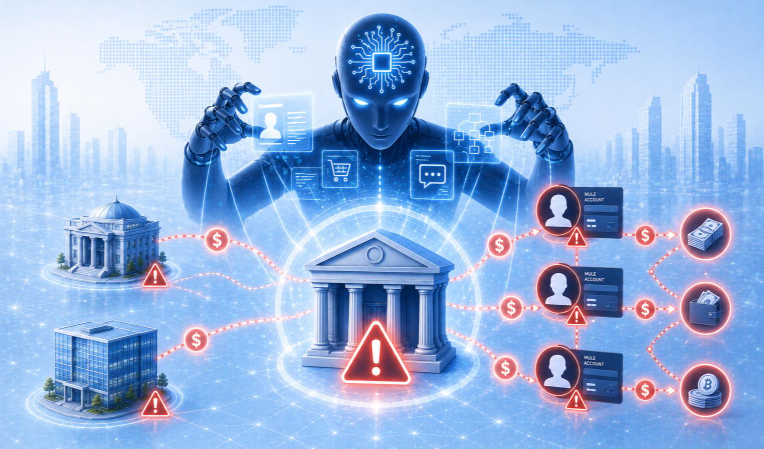
23 global experts predict how AI scams, deepfakes, money mule networks and automated fraud could reshape cybersecurity in 2027.
By News National Editorial Team
The global fraud landscape could undergo a major transformation in 2027 as artificial intelligence (AI), deepfake technology, automated scam operations and increasingly sophisticated identity theft techniques create new challenges for individuals, businesses and financial institutions.
A forecast published by financial technology company BioCatch on November 5, 2026, brings together 23 fraud and financial crime experts from different countries to examine how criminal activities could evolve in the coming year.
Their predictions point towards a common concern: fraudsters may increasingly use AI not simply to create convincing fake messages, but to operate entire criminal networks capable of targeting thousands of people simultaneously.
These are expert forecasts, not confirmed events or guarantees about what will happen in 2027.
BioCatch+1
1. AI-powered scams could become more convincing
One of the biggest expected threats is the use of generative AI to create highly personalised scams.
Criminals could use AI-generated voices, realistic video calls, fabricated identities and personalised messages to impersonate bank employees, government officials, business executives and family members.
Traditional warning signs, including unusual grammar, suspicious messages and poor-quality images, may become less reliable.
Victims could receive convincing communications that appear to come from organisations or people they already trust.
2. Deepfake impersonation and identity theft
Deepfake technology is expected to make identity-based fraud more sophisticated.
Fraudsters may combine stolen personal information with AI-generated faces and voices to impersonate genuine customers, bypass verification processes or manipulate employees into authorising financial transactions.
Banks and financial institutions may need stronger identity verification systems that examine behavioural patterns alongside conventional authentication.
3. AI-powered scam factories
Several experts anticipate that organised scam operations will increasingly automate their activities.
Instead of relying entirely on human operators, criminal networks could deploy large numbers of AI agents to:
-
Initiate conversations with potential victims.
-
Identify people likely to respond.
-
Conduct multilingual conversations.
-
Maintain communication around the clock.
-
Direct victims towards fraudulent payments.
Human criminals could then concentrate on managing high-value targets and extracting money.
This could increase the scale and efficiency of organised fraud operations.
4. Money mule accounts could become a major target
Money mule accounts are bank accounts used to receive, transfer or conceal illegally obtained funds.
Experts expect criminals to increasingly recruit people through fake employment opportunities, investment schemes and social media advertisements.
Some individuals may knowingly participate, while others may unknowingly allow their accounts to be used after being manipulated by scammers.
The growing connection between fraud and money laundering could make it more difficult for banks to identify suspicious financial transactions.
5. Authorised payment fraud could increase
An important emerging concern is authorised push payment (APP) fraud.
Unlike traditional account hacking, this type of fraud involves criminals convincing victims to transfer money themselves.
For example, a scammer may impersonate a bank security officer and claim that an account is under attack. The victim is instructed to transfer funds to a supposedly safe account.
Because the customer personally approves the payment, conventional security systems may not immediately recognise the transaction as fraudulent.
Experts believe banks will increasingly need to identify manipulation and suspicious customer behaviour before money leaves an account.
6. Fake online shopping advertisements
Fake shopping advertisements are another expected area of concern.
Fraudsters could use AI-generated product images, fabricated customer reviews, cloned websites and advertisements impersonating established brands.
Customers may pay for products that never arrive or unknowingly share payment and personal information with criminals.
Social media platforms, gaming applications and online marketplaces could face increasing pressure to identify fraudulent advertisements and remove suspicious sellers.
7. Scam compounds could become automated criminal businesses
International experts also warn that organised scam compounds could become increasingly automated.
These operations, some of which have been associated with human trafficking and forced criminal activity, could use AI to manage communications and coordinate fraud across international borders.
The relocation of criminal operations between countries may also complicate investigations and international law enforcement cooperation.
8. Financial institutions face a new cybersecurity challenge
Banks and payment providers may need to move beyond conventional identity verification.
The experts anticipate greater investment in:
-
Real-time behavioural intelligence.
-
Device and transaction monitoring.
-
AI-powered fraud detection.
-
Synthetic identity identification.
-
Cross-bank suspicious account intelligence.
-
Stronger anti-money-laundering controls.
-
Improved detection of manipulated customers.
The challenge will be distinguishing legitimate AI-powered financial activity from criminal automation without unnecessarily blocking genuine customers.
BioCatch+1
What does this mean for India?
India's expanding digital payment ecosystem makes fraud prevention particularly important.
UPI payments, mobile banking, online shopping, digital lending and social media transactions offer convenience but also create opportunities for criminals to target consumers.
The predictions from the 23 experts are particularly relevant to India's banking and cybersecurity sectors.
Indian fraud risk advisor Charanjeet Singh also highlights the growing challenge of agentic AI, warning that financial institutions will need to distinguish legitimate AI agents from malicious ones.
India already has an established cybercrime reporting mechanism. According to the Ministry of Home Affairs, the Indian Cyber Crime Coordination Centre (I4C) operates the National Cyber Crime Reporting Portal and the Citizen Financial Cyber Fraud Reporting and Management System.
As of June 30, 2026, the system had helped save more than ₹11,158 crore across over 32.80 lakh complaints, according to government figures.
Press Information Bureau
How people can protect themselves
Cybersecurity experts and financial authorities recommend several precautions:
-
Never share OTPs, UPI PINs, passwords or banking credentials.
-
Do not transfer money based on instructions from unknown callers claiming to represent banks or government agencies.
-
Verify video and voice requests for urgent payments through another trusted communication channel.
-
Avoid downloading unknown applications or granting remote access to your phone.
-
Check website addresses and seller credentials before making online purchases.
-
Never allow strangers to use your bank account to receive or transfer money.
-
Contact your bank immediately if you notice suspicious transactions.
How to report financial cyber fraud in India:
What should the world expect in 2027?
The 23 experts' predictions point towards a significant change in the relationship between technology, financial crime and cybersecurity.
AI could make fraud cheaper to organise, easier to personalise and more difficult to detect. Criminals may increasingly combine deepfake identities, automated communications, stolen personal information and international money mule networks.
However, AI will also become an important defensive technology for banks, regulators and cybersecurity professionals.
The central challenge for 2027 will be establishing digital trust: knowing who is communicating, who is authorising a transaction, whether that person is being manipulated and where the money is going.
For individuals, businesses and governments, preparing for these threats now could be critical to reducing financial losses in the years ahead.
Sources and references
-
-
-
-
Reserve Bank of India – Financial cyber fraud prevention guidance. RBI guidance.