
Language Settings
Select Website Language

GDPR Compliance

We use cookies to ensure you get the best experience on our website. By continuing to use our site, you accept our use of cookies, Privacy Policy, and Terms of Service.

Filters

Channels
Topics
Other Filters

Attitude Over CV Top Bosses Reveal What Gets You Hired

Charlotte Tilbury, Marcia Kilgore, Charlie Nunn and other founders share the one quality they look for when hiring and how to stand out. What gets someone hired and helps them climb? For six business founders and leaders, the answer has little to do with a flawless CV. They point instead to attitude, curiosity, communication and a willingness to take chances. Each shared the qualities they notice most and the advice they would give to anyone trying to get ahead. Beauty mogul Charlotte Tilbury says the biggest driver of her career has been refusing to let other people decide what she can achieve. "Nothing is impossible in life - it's only your own limitations you give yourself," she says. Plenty of people told her she was "mad" or that her ideas would fail, and her advice is to ignore them. She also reframes failure. "I don't think about mistakes, I think mistakes are opportunities," she says, adding that the toughest challenges she faced made her a stronger leader because "challenge is opportunity and it leads you to greater places." Skills can be taught, attitude cannot Charlie Bowes-Lyon, co-founder of the deodorant brand Wild, weights character far above technical ability. "For me, it's 90% attitude and 10% skills, as skills can be taught, attitude can't," he says. He wishes he had understood earlier that even successful people rarely feel as assured as they look, describing it as "everyone is faking it until they're making it." Bowes-Lyon also has a practical warning for interviews: prepare questions to ask at the end. "Candidates who say they have no questions rarely get the job," he says. One he recommends is to ask the interviewer what success in the role actually looks like. Marcia Kilgore, the serial entrepreneur behind Beauty Pie and Soap and Glory, says curiosity is one of the main things she hires for. She looks for people who will "roll their sleeves up, ask lots of questions and think about how they can be useful." She also rates communication highly, having learned early in her career that a breakdown in communication is often what causes things to go wrong. Her tip is to slow down before speaking. "Listen to what's being asked and take a breath or five," she advises. "Your response doesn't have to be immediate, but it does have to be considered." Say yes, and match EQ to IQ Anabel Kindersley, chief executive and co-owner of Neal's Yard Remedies, believes the fastest way to build skills is to keep accepting new opportunities. "Do everything and say yes to everything - it might feel uncomfortable but do it anyway," she says. It is a rule that has shaped her own path, which moved from child actress to author and later into business. Kindersley adds that honesty counts for a lot, urging people to be truthful about their experience while staying confident about what they bring. When she hires, she wants "equal EQ as IQ," placing emotional intelligence on the same footing as raw ability. Charlie Nunn, group chief executive of Lloyds Banking Group, points to curiosity and resilience, along with a growing readiness to consider how AI tools can be put to use in the future. Taken together, the leaders describe a shared checklist that has less to do with credentials than with mindset: back yourself, treat setbacks as material to learn from, ask questions, communicate with care, and stay open to work that stretches you. career advice, job interview tips, Charlotte Tilbury, Marcia Kilgore, Charlie Nunn Lloyds, hiring qualities, workplace success, attitude over skills

Europe's Royals Gather in Oslo to Bid Farewell to King Harald V

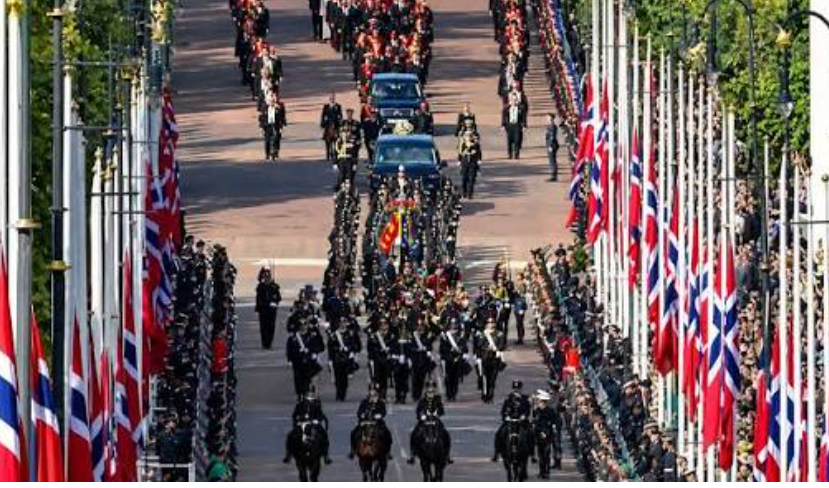
Prince William, three Nordic kings and President Zelensky joined mourners in Oslo as Norway laid King Harald V to rest after 35 years on the throne. Norway said goodbye to King Harald V on Wednesday, as scores of European royals and heads of state travelled to Oslo for a funeral held nearly two weeks after the monarch's death at the age of 89. The Prince of Wales and three Nordic kings were among those who gathered to honour a ruler who spent 35 years on the throne. The day's events opened at Akershus Fortress, the medieval castle overlooking the capital where Harald was later buried. A funeral procession then moved from the royal palace to Oslo Cathedral, watched by thousands of people who filled the streets along the route. A minute's silence was held across the whole country. Harald's son and successor, King Haakon, walked behind the coffin on foot. He was joined by his sister, Princess Märtha Louise, and his two children, Crown Princess Ingrid Alexandra and Prince Sverre Magnus. Queen Mette-Marit, who recently came through a lung transplant, travelled by car alongside the late king's 89-year-old widow, Queen Sonja. Prince William attended on behalf of his father, King Charles III. The Princess Royal was also present, though in a private role as godmother to Norway's new king. The pair were part of a group of around 30 royal guests drawn from Sweden, Denmark, Belgium, Spain, Monaco, Jordan and Japan. Among them were Sweden's King Carl XVI Gustaf, King Frederik X of Denmark, Princess Beatrix of the Netherlands and Queen Letizia of Spain. The guest list reached well beyond Europe's palaces. Ukrainian President Volodymyr Zelensky and German President Frank-Walter Steinmeier walked behind the coffin, and five foreign prime ministers also joined the mourners. A eulogy inside the cathedral During the service, Norwegian Prime Minister Jonas Gahr Støre delivered a eulogy praising the late king. He said Harald had managed to strike "a balance between being stately and down-to-earth" and that the monarch had "made Norway greater". Emotions ran high in the pews. Queen Mette-Marit was seen dabbing at her eyes, and Queen Sonja, visibly moved, placed a single red rose on her husband's coffin. One unscripted moment marked the ceremony. As three tolls of the cathedral bell signalled the end of the minute's silence, the solemn pause was briefly broken by a mobile phone alarm sounding in the crowd. Marius Borg Høiby, the late king's step-grandson, was granted permission to attend the service. A modernising monarch Harald had reigned for 35 years and was regarded as a popular figure who helped move the monarchy with the times. Those who followed the royal family often described him as widely respected and cherished, a figure many Norwegians thought of as a grandfather to the nation. The country observed 13 days of national mourning before the funeral took place. In the day after his father's death, Haakon paid tribute to him, thanking him for "being such a good dad" and saying the king had "always stayed true" to his beliefs and commitments. The final stretch of Harald's life had not been without difficulty. He and those close to him had dealt with personal strains and public controversy in his last months. After the burial, the Norwegian royal family appeared on the palace balcony to acknowledge the crowds below. King Haakon stood alongside Queen Mette-Marit and Queen Sonja as they greeted the people who had come to mark the end of one reign and the start of another. King Harald V, Norway royal funeral, King Haakon, Oslo Cathedral, Prince William, Queen Sonja, Norwegian monarchy, Volodymyr Zelensky

Chinese Mukbang Star Chen Ziyi Dies at 24 After Health Alarm

Chen Ziyi, the Chinese mukbang creator known as Ganfan Yingying, has died at 24, days after telling fans her potassium had fallen to a dangerous 2.3 mmol/L. Chen Ziyi, a Chinese online personality who drew a wide audience with her extreme eating videos, died on August 17, 2026, at the age of 24. Her parents confirmed the death, according to reports in Chinese media, but did not release an official medical cause. The announcement followed by only a few days a video in which Chen, who went by the online name Ganfan Yingying, told viewers she had been admitted to hospital. On August 14 she said her blood potassium reading had slipped to 2.3 mmol/L, far below the level doctors consider safe. Typical laboratory reference ranges put normal potassium at roughly 3.5 to 5.0 mmol/L, though the exact figures differ from one lab to another. Chen had roughly 1.2 million followers spread across her social media accounts. Her fame rested on mukbang, a style of video in which the host consumes very large quantities of food on camera while chatting with an audience watching in real time. The format first caught on in South Korea before spreading to other countries, including China. In the same message about her hospital stay, Chen admitted that she had at times forced herself to throw up after big eating sessions, hoping to keep her weight down. That behaviour carries a clear physical danger: frequent vomiting strips the body of potassium and can push it into hypokalemia, the clinical term for critically low potassium. She had spoken before about the strain of her work. Eating enormous amounts on camera while trying to stay slim, she said, was a constant struggle. That tension surfaced starkly in her last uploads. Chen closed her final video with a direct appeal to the people who followed her. "Although making money is important, health should always come first," she said. The remark landed with unusual weight once she died so soon afterward. What the low potassium reading meant Potassium keeps muscles and the heart working normally, which is why a sharp drop can turn dangerous. When levels fall far enough, the heart can beat irregularly, and severe cases can prove fatal. Repeated vomiting is one of the recognised routes by which the body sheds the mineral in large amounts. Some accounts of Chen's death pointed to cardiac arrest brought on by her very low potassium as a likely explanation. That link was raised in reporting but was never confirmed by her family, who declined to state a specific reason for her death publicly. Renewed scrutiny of extreme eating content Chen's death has reopened debate about the physical cost borne by creators who build audiences around eating to excess. Her parting words suggested she understood how heavily the work was weighing on her body, even as she kept producing it. She was not the first in the field to suffer serious harm. Pan Xiaoting, another Chinese creator, died in 2024 after reportedly falling ill in the wake of extreme eating livestreams. Her case had already prompted questions about the wisdom of turning oversized meals into a form of entertainment. For the people who followed Chen, the lasting takeaway from her last video was the plainest part of it: no amount of income or online attention is worth sacrificing one's health. Chen Ziyi, Ganfan Yingying, mukbang creator death, extreme eating, hypokalemia, low potassium, Chinese social media, Pan Xiaoting

Malenadu's 'Rain Stars': How Farmers Read the Monsoon

In Karnataka's Malenadu, farmers time sowing and harvest to nakshatras or 'rain stars' - each fortnight bringing its own rain, wind and rare monsoon dishes. In the hill country of Malenadu in Karnataka, the monsoon is not treated as a single long season but as a chain of distinct phases, each tied to a nakshatra, or "rain star." The name Malenadu - also called Malnad - means "land of rains," and generations of farmers here have timed their fields to the sun's passage through specific constellations. Radhika Hegde described the system in an essay in Deccan Herald, framing the rains as a succession of stars rather than one unbroken spell. The calendar farmers follow is the Panchanga, the Vedic almanac. In Malenadu it is read for the "mallay," or rain, nakshatras. Each transit of the sun through a constellation lasts a fortnight and carries its own signature of rain, temperature and wind. Around those markers, farmers begin sowing seeds or spraying their areca nut trees. The link is old: the 1923 edition of the Mysore calendar set out the five limbs of the Panchanga - tithi (lunar day), vara (weekday), nakshatra (star constellation), yoga (sun-moon alignment) and karana (half of a tithi) - and tied them to the work of crops. From Mrigashira to Swati The cycle begins around June 7, when the sun enters the Mrigashira nakshatra. Known as Mrigashira Karte in traditional calendars, it brings the first gentle rains and the right conditions for sowing millets and herbs. The sun then moves into Arudra, when the monsoon builds into heavy, non-stop downpours that fill the streams and soak the parched ground. Punarvasu follows with steady, dependable rain, the moment to transplant paddy into the fields. After that comes Pushya, marked by relentless rain and strong gusty winds, and Ashlesha, whose heavy drops one folk account compares to "pouring rice." The next month brings Magha, called "Sheetah Maghe" for its bitterly cold showers. Purva Phalguni, known locally as Pubba, arrives with thunder, lightning and rain that starts and stops without pattern. The sequence runs on until Swati, when the monsoon finally winds down. Farmers have compressed centuries of watching the sky into short, rhythmic couplets and proverbs known in Kannada as Gade Maathu. Most are compact and plain-spoken. One runs: "Ashwini male bidre, arishinake melu" - early rains in the Ashwini star give the turmeric crop a head start. Food that only the rains bring The wet months also shape the Malenadu kitchen, where cuisine and climate are closely linked. Among the region's more unusual dishes is chigli chutney, made from kempu iruve, or red weaver ants. It is eaten by tribal communities such as the Siddhis and Soligas. Someone climbs a tall tree to bring down a weaver ant's nest and drops it into a bag, which is then emptied into a pot over a fire with salt. Once cooked, the ants are ground with garlic, bird's eye chili, coconut, salt and sometimes tamarind. The protein-rich paste is believed to guard against cold and cough through the winter. Other monsoon foods lean on the season's flush of greenery. A stir fry is made from young bamboo shoots. Mara kesu, the reddish Colocasia leaves that grow on trees only during the rains, are turned into a patrode-style dish, with the batter rolled in a banana leaf and steamed. Kaalu kadubu takes the idea further: jackfruit leaves are stitched together to hold the batter, into which a range of gourds and vegetables are grated before steaming, much like idli. It is served with a ghassi, or sambar, made from pumpkins, melons and gourds. The abundance of large leaves has uses beyond the plate. Shubha Bhat, who grew up near Karkala, recalls holding giant Colocasia leaves over her head as a child to keep off the rain - a simple, ready-made umbrella from a land defined by its downpours. The account of Malenadu's rain stars and rainy-season food was drawn together by Shoba Narayan, a Bengaluru-based author who writes on art, food, fashion and travel, drawing on Hegde's essay and conversations with people from the region. Malenadu monsoon, rain stars nakshatra, Malnad farming, Panchanga calendar, Karnataka monsoon, chigli chutney, areca nut cultivation, Kannada rain proverbs

Van de Zandschulp Reaches US Open Quarterfinals "botic van de zandschulp"

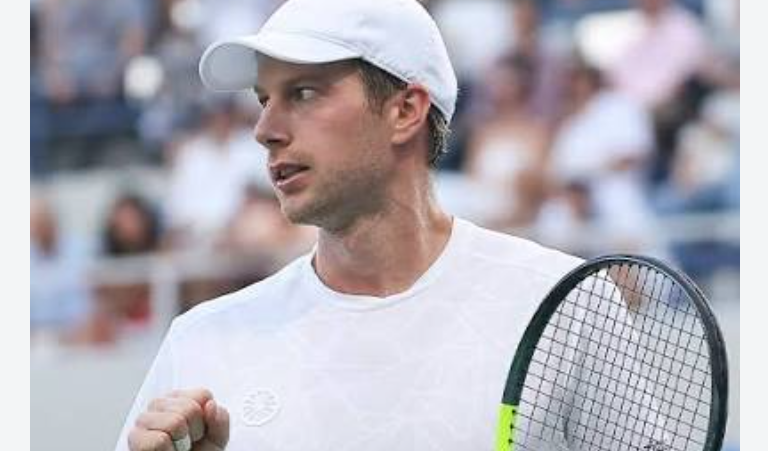
Botic van de Zandschulp has advanced to the US Open quarterfinals, and searches for the tennis player are surging in India. Botic van de Zandschulp has reached the quarterfinals of the US Open, one of tennis's four Grand Slam tournaments. The run has pushed his name into wider public view, and interest in the player has spread well beyond the sport's usual audience. Searches for "botic van de zandschulp" climbed sharply on Google Trends in India, passing 100 or more queries as fans looked for information about the quarter-finalist. The spike points to a growing curiosity among Indian tennis followers about a name many were encountering for the first time. Reaching the last eight at a Grand Slam places van de Zandschulp among the final contenders at the tournament. To get there, a player must win multiple rounds against a field that includes many of the world's leading professionals, making the quarterfinal stage a marker of a strong campaign. Beyond his advance to the quarterfinals, further details of van de Zandschulp's US Open path were not immediately available. What is clear is that the result has drawn fresh attention to the player, with the online interest in India tracking closely to his progress at the tournament. The quarterfinal stage sets up the closing rounds of the US Open, where the remaining players compete for a place in the semifinals and, ultimately, the title. Van de Zandschulp's presence at that stage confirms his standing as one of the tournament's final eight. Botic van de Zandschulp, US Open, US Open quarterfinals, tennis, ATP Tour, Grand Slam tennis, van de Zandschulp

BGMI Bloodline Awakening 50 Redeem Codes Live Until Sept 25

Krafton India rolls out 50 BGMI redeem codes for the new Bloodline Awakening vampire mode. Codes work until September 25 through the official Redeem Centre. Krafton India has released 50 fresh redeem codes for Battlegrounds Mobile India (BGMI), tied to a new limited-time mode called Bloodline Awakening. The codes unlock exclusive in-game rewards and stay active until September 25, after which they stop working. Players must claim them through the game's official Redeem Centre. The reward drop arrives just ahead of the BGMI 4.6 Update. Alongside the codes, Krafton India is launching Bloodline Awakening, a temporary game experience built around vampires, hunters and a supernatural twist on the usual match flow. The mode adds PvE threats and hands players special powers they cannot use in standard matches. The headline feature lets defeated players rejoin the fight as vampires. Once revived, they gain four abilities: Claw Strike, Absorb, Blood Sense and Blood Amberfication. This turns elimination into a second chance rather than the end of a round. The full list of 50 codes Below are the general redeem codes shared by Krafton India: LUZBZUE7QCHWA37C, LUZCZDHE66ATD39R, LUZDZXVNHU5QMDFW, LUZEZB7PUNWE9PFU, LUZFZTSH8SNBTWKD, LUZGZMAMM7VB7TVX, LUZHZCNXWA5S3BA6, LUZIZXK39RXPP9NC, LUZJZFQSUE4T5XPP, LUZKZQ9RXXAKQMKK, LUZLZP8XNJFFUJN4, LUZMZNTPXCJ7MRD5, LUZNZDWAS4N8S4DW, LUZOZFXS9G5J9XHQ, LUZPZHPQ4TAJ4M84, LUZQZFMDXND9XWB3, LUZRZ3QVMH5GAA5F, LUZVZESSQNN5V556, LUZTZ45HJAAH46K5, LUZUZ364SN6TH3S6, LUZBAZXPT79SQVQW, LUZBBZG3FWK43NS9, LUZBCZMN68UUEA6F, LUZBDZ83HAKEXPAE, LUZBEZ9VTVU4U3U9, LUZBFZJNPVM3NRKM, LUZBGZ5TAS57EDQ7, LUZBHZK5SS8GSE9U, LUZBIZ6WTQCUHNDJ, LUZBJZQNGEDUBGDV, LUZBKZHQ677H5P53, LUZBLZVS8QQT473X, LUZBMZCCDFUKMUSQ, LUZBNZBV3XRPAHVQ, LUZBOZJAC9U5MBBE, LUZBPZ3N8VVSBTF9, LUZBQZCQK355DC4W, LUZBRZE7XJWGUWUR, LUZBVZFHPGW7V77E, LUZBTZGN6V5EGJNF, LUZBUZVMJCHJ7Q6P, LUZCAZGAAXGEBEP7, LUZCBZRX9ETBXA3E, LUZCCZ89XC7QTM5B, LUZCDZ9TT8DU73J8, LUZCEZK3HCF3TCFX, LUZCFZSW8375KQ6K, LUZCGZK4JBU3KFUX, LUZCHZHMM37QTQS3, LUZCIZJGCUT8CC4P. How to redeem and what to watch for To claim a reward, open the official BGMI Redeem Centre and enter your Character ID. Next, type in the redemption code, clear the Captcha check and tap Redeem. A successful claim sends the item straight to your in-game mail. The rules are strict. Each code works for only 10 players, handed out on a first-come, first-served basis, so many will hit their cap fast. A player can enter just one code a day, and any single code can be used only once per account. Once a code expires or fills its 10-player limit, it stops working and shows an expiry notice. Guest accounts cannot use the codes at all. After redeeming, players get a confirmation message. Rewards sitting in in-game mail must be collected within 30 days, or the mail expires and the item is lost. BGMI redeem codes, Bloodline Awakening, Krafton India, BGMI 4.6 update, BGMI Redeem Centre, BGMI vampire mode, in-game rewards, Battlegrounds Mobile India

Coforge Falls 6% After Chairman OP Bhatt Quits Board

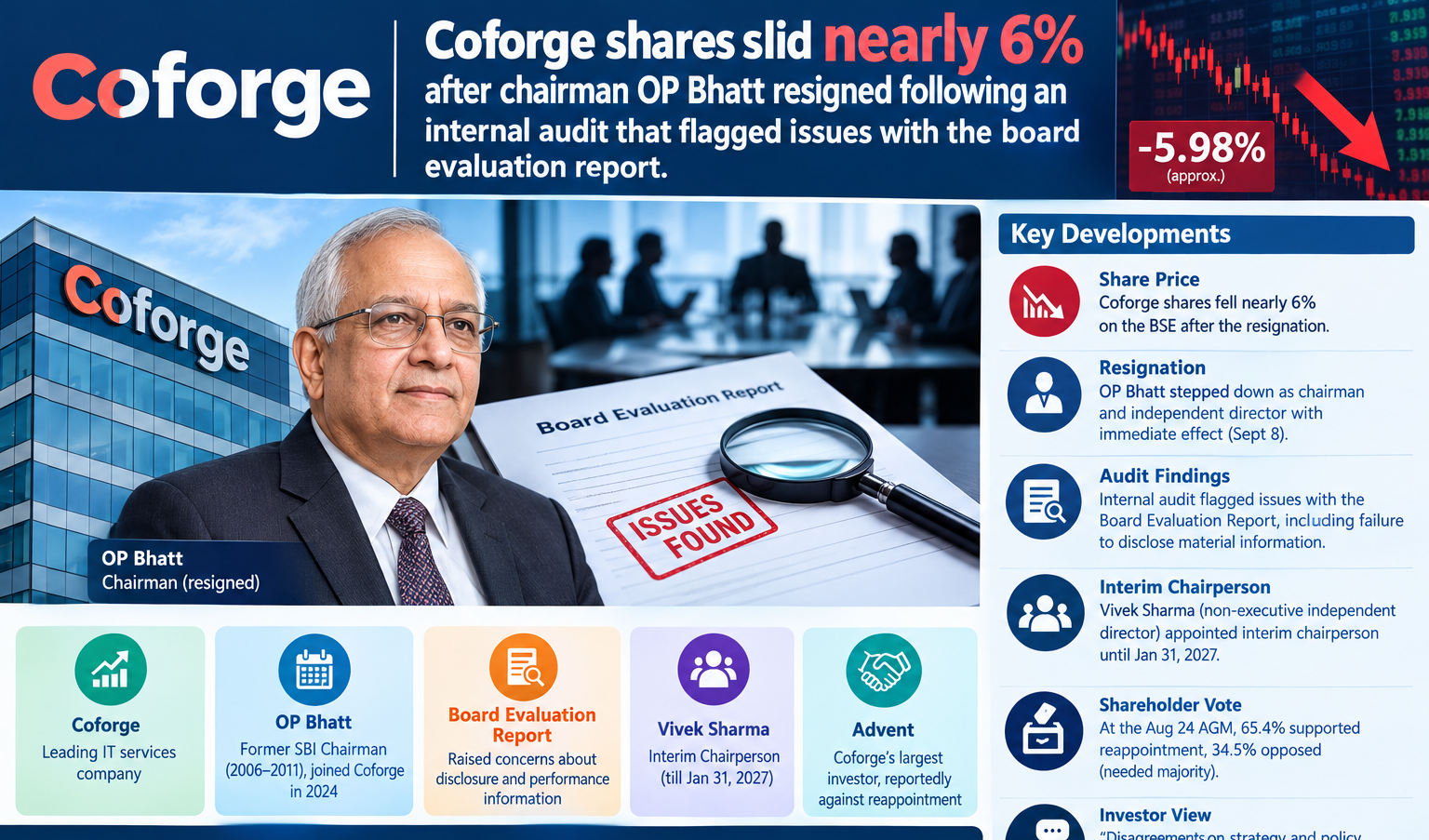
Coforge shares slid nearly 6% after chairman OP Bhatt resigned following an internal audit that flagged issues with the board evaluation report. Shares of IT services firm Coforge fell close to 6% on the BSE on Tuesday after OP Bhatt stepped down as chairman and independent director with immediate effect. The departure came after an internal audit review raised questions about the way the company handled and presented its board evaluation exercise. Bhatt, who took over as Coforge chairman in 2024, had earlier led the State Bank of India as its chairman between 2006 and 2011. He submitted his resignation on September 8, while the board was still weighing his response to the audit's findings. According to a regulatory filing, the audit was carried out as part of Coforge's plan for the September quarter of FY26. It flagged problems with the Board Evaluation Report, including the failure to disclose certain material information about the report and about the chairman's own performance when the document was placed before the board. The board had put these concerns to Bhatt and asked him to explain. He replied, but no final call had been taken when he chose to step aside. "The Board considers it important to clarify that the chairman's resignation followed the concerns identified in the internal audit review and the subsequent process undertaken by the Board to seek and consider his explanation," the company said. In his resignation email, Bhatt tied his exit directly to the evaluation dispute. "I believe that continuing on the Board while there remains a disagreement considering the characteristics of my good faith actions in the Board evaluation process would not be conducive to the effective functioning of the Board," he wrote. He said these matters were the material reasons for leaving and that no others applied. Bhatt also defended his conduct, saying he had carried out his role as independent director and chairman with a "strong sense of responsibility" and had tried to act independently while weighing the interests of shareholders, management and the company. Coforge has named non-executive independent director Vivek Sharma as interim chairperson, a role he will hold until January 31, 2027. Bhatt will also step down from all board committees at once. The resignation follows a bruising shareholder verdict last month. At the company's 34th annual general meeting on August 24, a special resolution to reappoint Bhatt as an independent director drew 65.4% of votes in favour and 34.5% against, short of the majority it needed to pass. Governance analysts pointed to friction with Coforge's biggest investor. "It looks like disagreements on strategy and policy matters between the chairman and the largest shareholder, Advent, seem to have led to this resignation," said Shriram Subramanian, managing director of corporate governance research firm InGovern Research Services. He noted that the proposal to reappoint Bhatt from May 2027 was rejected at the August 24 meeting, with Advent voting against it. Coforge, OP Bhatt, Coforge share price, board evaluation report, Vivek Sharma, Advent, InGovern, corporate governance

Amruta Fadnavis Backs Muslim Entry to Garba Amid Row

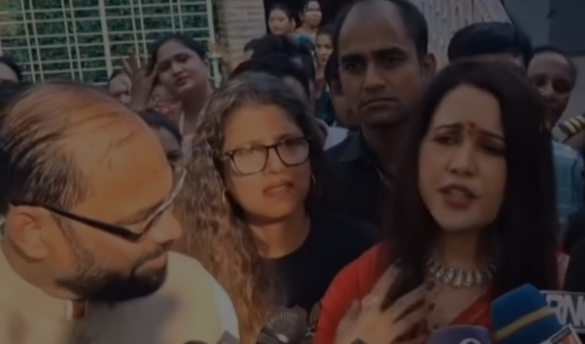
Amruta Fadnavis says nothing is wrong if Muslims come to watch or enjoy Garba, breaking with BJP leader Nitesh Rane and a VHP appeal to bar them. Amruta Fadnavis, wife of Maharashtra Chief Minister Devendra Fadnavis, has said there is nothing wrong if a Muslim person comes to watch or enjoy Garba, wading into a growing row over religious restrictions at Navratri celebrations. Speaking to reporters in Chandrapur, she argued that Garba should not be confined to a single community and should remain a festival that brings everyone together. She made the remarks after attending a Rudrabhishek programme at Chandrapur's largest Mahashivling temple. Asked about the controversy, she said festivals and celebrations are meant to be shared by all, and that stopping anyone from watching or taking part in Garba is not right. It is an event in which everyone can join, she said. Her comments set her apart from the position taken by BJP leader Nitesh Rane, whose statement opposing the entry of Muslims into Garba events triggered the dispute. Rane backed an appeal by the Vishva Hindu Parishad seeking a ban on Muslims taking part in Garba and Dandiya programmes across the state during Navratri. The VHP guidelines call for no Muslim entry and make Aadhaar identification and a tilak mandatory at venues. The intervention sharpened the political debate around the festival. Fadnavis framed her view around inclusion rather than restriction. Celebrating festivals is important, she said, because they bring happiness and energy to society. But she paired that with a caution: public events must be mindful of others. Rules for public celebrations While defending open participation, Fadnavis stressed that public gatherings should follow the rules set for them. A community's celebration should not cause trouble to anyone else, she said, and programmes held in public spaces must stay within the limits laid down for them. Faith and religious observance, she added, can be practised within one's own home, but in public places compliance with the rules is necessary. She also addressed the use of DJs at public functions, a recurring flashpoint during Navratri. There is no call for a complete ban on DJs, she said, but the volume and the timing must adhere to the prescribed norms. People should recognise their own responsibility during festivities, she added, because loud sound can disturb residents living nearby. Events, in her view, should be conducted with restraint. Respecting everyone's feelings During the same interaction with the media in Chandrapur, Fadnavis touched on other issues, including the controversy over a statement by Sambhaji Bhide concerning women. She returned repeatedly to the theme of following rules in public events and social matters. Everyone's feelings in society deserve respect, she said, and no celebration should be allowed to create an atmosphere that gives rise to a dispute. Her message balanced two ideas she kept coming back to: that festivals should be open and shared, and that they should be conducted responsibly so that they do not become a source of friction. Amrita Fadnavis, Garba controversy, Muslim entry Garba, Nitesh Rane, VHP Garba guidelines, Navratri Maharashtra, Chandrapur, Devendra Fadnavis

Rockstar Co-Founder Dan Houser's 2026 Fortune Reaches $250 Million

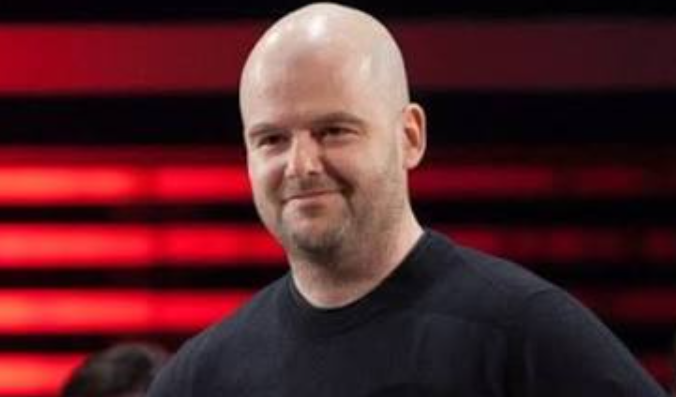
Dan Houser, who co-founded Rockstar Games and shaped Grand Theft Auto, is valued at $250 million in 2026 as GTA 6 nears a November release. Dan Houser, the British writer and producer who helped launch Rockstar Games and steer the Grand Theft Auto series, is valued at an estimated $250 million in 2026, according to Celebrity Net Worth. The figure reflects earnings from more than two decades spent building one of gaming's most lucrative catalogues, even though Houser left the studio in March 2020. Houser co-founded Rockstar and served as its central creative voice for most of his tenure, working on Grand Theft Auto, Red Dead Redemption and Max Payne. His wealth continues to rest on those franchises, and a fresh source of income looks likely: Grand Theft Auto 6 is scheduled to arrive in November 2026, promising another surge of sales for the series he helped shape. Houser was born in London in 1974. His father worked as a lawyer and his mother was an actress. He and his older brother Sam grew up drawn to American crime and gangster movies, an interest that later shaped the tone of their best-known games. Dan entered the industry in 1995 with a job at BMG Interactive, where he tested CD-ROMs, and Sam joined him not long after. The brothers acquired the rights to a title called Race'n'Chase and reworked it under a new name: Grand Theft Auto. When Take-Two Interactive bought BMG in 1998, the pair relocated to New York and set up Rockstar Games as a Take-Two label, alongside co-founders Terry Donovan and Jamie King. From gangster films to open worlds Grand Theft Auto borrowed the familiar beats of crime cinema and rebuilt them as a sprawling open-world game, an approach many at the time regarded as a breakthrough. The series drew steady criticism for its violence and adult themes, yet its audience kept expanding rather than shrinking. The sales record underscores that reach. Grand Theft Auto V has shipped 110 million copies since its 2013 debut, and Rockstar has moved more than 300 million games across its full lineup. The GTA franchise alone has brought in more than $6 billion worldwide, ranking it among the highest-earning entertainment properties ever made. Property deals and life after the studio Houser stepped away from Rockstar after roughly 22 years, ending the day-to-day creative role he had held for nearly his entire career. He is married to Krystyna Jakubiak, a voice actress born in Russia. His property dealings offer a further measure of his finances. In 2006 he purchased a SoHo apartment for $6.35 million and sold it in 2013 for $9.6 million. In 2012 he paid $12.5 million for a Brooklyn mansion once owned by the writer Truman Capote, a sum reported as a record for the area at the time. Dan Houser net worth, Rockstar Games, Grand Theft Auto, GTA 6, Take-Two Interactive, Sam Houser, Red Dead Redemption, video game producer

BYD Sealion 6 Plug-In Hybrid Spotted Testing In India

BYD's first plug-in hybrid for India, the Sealion 6 with DM-i tech, has been spied testing. It promises a 1,200 km total range and could launch in 2026. BYD, better known in India for its all-electric cars, has been spotted testing its first plug-in hybrid for the country. Test cars for the BYD Sealion 6, wearing camouflage and prominent decals reading "BYD DM-i" and "Super Plug-In Hybrid" along the sides, were seen on Indian roads. The rear carried further "BYD DM-i" and "World's No.1" branding, confirming the vehicle runs the company's proprietary DM-i plug-in hybrid system. The Sealion 6, sold in some markets as the Seal U, marks a departure for BYD in India, where the brand has so far offered only electric vehicles. The company has previously launched the Seal sedan and the Sealion 7, both part of its Ocean lineup, and the Sealion 6 is set to widen that range. Reports had for some time pointed to BYD preparing a plug-in hybrid for India, with both the Atto 2 and the Sealion 6 seen testing on public roads as likely candidates. The latest sighting settles which model carries the technology. The DM-i powertrain At the heart of the Sealion 6 DM-i is a 1.5-litre turbocharged petrol engine paired with two electric motors - a starter motor and a traction motor. BYD claims the engine reaches a thermal efficiency of 43.04 per cent, which it says is the highest in the world. The motors are rated at 97.5 per cent efficiency and draw power from an 18.3 kWh battery pack built with the company's Blade cells. With a full fuel tank and a fully charged battery, BYD says the Sealion 6 DM-i offers a combined range of 1,200 km. On battery power alone, the car is claimed to cover 126 km on a single charge. The same powertrain configuration is expected to reach the Indian market unchanged. Size and styling The Sealion 6 measures 4,775 mm in length, 2,085 mm in width and 1,670 mm in height, and rides on a 2,765 mm wheelbase. Its proportions place it firmly among BYD's Ocean-series models, alongside the Sealion 7 already on sale in India. Where the two differ is in character. The Sealion 6 carries sharper creases and a more upright, SUV-like silhouette, giving it a more European look and a more practical stance than the sportier Sealion 7. Inside, the model is expected to bring features seen elsewhere in BYD's range, including a rotating touchscreen, a TFT instrument cluster, advanced driver-assistance systems, high-quality cabin materials and generous boot space. Launch timing and rivals BYD India has not confirmed a launch date for the Sealion 6 plug-in hybrid, but 2026 appears to be the target year. The company is expected to bring the model in through the CBU route, importing it as a completely built unit rather than assembling it locally. In the Indian market, the Sealion 6 is set to line up against the upcoming Jetour T2 plug-in hybrid, which will be sold under the JSW brand. The arrival of the DM-i system would give Indian buyers a BYD model that runs on both petrol and electric power, a shift from the brand's electric-only presence in the country so far. BYD Sealion 6, BYD PHEV India, DM-i technology, plug-in hybrid India, BYD Seal U, Sealion 6 launch, BYD Blade battery, Ocean series

Meta Still Running AI Child Abuse Ads in India, Report Finds

The Tech Transparency Project says it found 332 ads with AI-generated child abuse imagery on Facebook and Instagram, 84 of them running in India. Meta approved and ran hundreds of paid advertisements containing artificial intelligence-generated child sexual abuse imagery over the past 10 months, with dozens of them appearing in India, according to a new report from US-based campaigners. The Washington-based Tech Transparency Project (TTP) said it counted 332 such adverts across Facebook and Instagram, with the bulk of them - 274 - surfacing in August alone. The findings, published Tuesday, land roughly two months after India's government instructed Meta to strip all advertising and content promoting child sexual abuse material (CSAM) from Instagram. That directive followed a BBC Eye investigation that exposed paid Instagram ads promoting such material to Indian users. Of the 332 ads TTP documented, 84 - about a quarter - ran in India. Seventy-eight of those Indian ads went live after New Delhi issued its removal order and held talks with senior Meta executives, the report said. The remaining advertisements reached audiences in the United States, the United Kingdom, the European Union and Australia. TTP said more than a dozen of the ads stayed active on Meta's platforms even after the group flagged them directly to the company. Researchers reported every advert they identified to the National Center for Missing and Exploited Children (NCMEC), the global clearing house for reports of online child exploitation. The report describes a recurring pattern in how the ads were built. Nearly all began with a genuine photograph of a child that was then altered with AI tools. TTP said it traced several of the source images to real children, among them a member of a European royal family. Asked about the findings, Meta said it does not permit such material on its services. "We don't tolerate nudify apps or any kind of child exploitation, whether real or AI-generated," the company said in a statement. "These criminals constantly shift tactics to evade detection, which is why we keep strengthening our detection and enforcement." Meta added that when it identifies apparent child exploitation, it refers the case to NCMEC to meet its legal reporting duties. The company's own advertising rules bar any ad that sexually exploits or endangers children. In India, distributing CSAM is a criminal act. Supreme Court petition and government scrutiny Child protection advocates in India argue that reporting cases to a US-based body falls short of what the law demands. Bhuwan Ribhu, who founded Just Rights for Children - a coalition of more than 250 organisations working against violence targeting children in India - said platforms are sidestepping their obligations. "Social media companies are clearly flouting Indian laws by not reporting child sexual abuse content to Indian law enforcement agencies as mandated by our child protection laws," Ribhu said. Just Rights for Children has taken the issue to India's Supreme Court, filing a petition that draws on the BBC's earlier reporting. The group is asking the court to order social media firms to make reporting mandatory and to identify the people behind CSAM promotion. Several government bodies have also begun looking into the matter following the BBC investigation, including the National Commission for Protection of Child Rights and the National Human Rights Commission. Who compiled the findings The Tech Transparency Project operates as a research arm of the non-profit Campaign for Accountability, which focuses on scrutinising major technology firms. Its latest count covers ads spanning five markets - the US, UK, EU, Australia and India - and the group says it has passed all 332 advertisements to NCMEC. The report keeps pressure on Meta at a moment when Indian regulators and courts are already weighing how far the company must go to keep such content off Facebook and Instagram, and whether reporting to a foreign agency satisfies domestic legal requirements. Meta CSAM ads, Tech Transparency Project, Instagram India, AI-generated child abuse, Just Rights for Children, NCMEC, child protection India, Facebook advertising

Royal Enfield GTR 750 Spied in Chennai, Launch Nears

Royal Enfield GTR 750 Spied in Chennai, Launch Nears A faired Royal Enfield Continental GTR 750 has been spied testing in near-production form in Chennai, with a possible launch by late 2026 or 2027. Royal Enfield is testing a faired version of its Continental cafe racer built on an all-new 750cc platform, and the motorcycle has been spied on public roads in near-production form. The bike, unofficially referred to as the Continental GTR 750, has been caught testing multiple times, and the rising frequency of test mules points to a launch drawing closer The company has not confirmed the name or a firm timeline, but a launch is expected by the end of 2026 or in 2027. The GTR 750 is one of two variants under development: the faired model carrying the GTR badge, and a version without any fairing that is likely to be called the Continental GT 750. Both have been spotted testing, though neither name has been made official. The project is part of Royal Enfield's push to widen its multi-cylinder range. Test mules and official teasers have already surfaced, and the new bikes will use a 750cc engine expected to be a bored-out version of the current 650cc unit. The first model to reach the market could be either a Himalayan 750 or the Continental GT 750, with the faired GTR following. What the spy shots show Unlike the current Continental GT 650, the new cafe racer gets a fairing. It does not fully enclose the engine bay, as is common with faired cafe racers, but it wraps around the circular headlight to form an integrated flyscreen for improved wind protection. The latest test mule shares the same features seen in earlier sightings. The GTR 750 is expected to run clip-on handlebars for a committed, sporty riding position. The spied unit also carries bar-end mirrors and alloy wheels. The engine bay and the exhaust pipes are finished in matte black for a sportier look, and the bike uses a twin-exhaust layout with one pipe on each side. A key point of difference over the 650 is braking. The 750 gets a dual-disc setup at the front, which is visible on the test unit. That marks it out from the single front disc of the current cafe racer. Engine and equipment The all-new 750cc parallel-twin is oil-cooled and is expected to be a big-bore version of the existing 650cc parallel twin. The current 650cc engine produces around 47 bhp and 52 Nm and is paired with a six-speed gearbox. The 750cc unit is likely to push output to roughly 50-55 bhp and more than 60 Nm. On equipment, the Continental GTR 750 is expected to offer dual-channel ABS, a slipper clutch and all-LED headlights shared with other Royal Enfield models. The suspension setup is expected to comprise right-side-up telescopic front forks and twin rear shock absorbers, along with tubeless tyres. The instrument cluster appears to retain the twin-pod design seen on other Royal Enfields. One of those pods could house a Tripper screen for Bluetooth connectivity and turn-by-turn navigation, though that has not been confirmed for this model. With test activity increasing and the hardware appearing close to final specification, the GTR 750 looks set to expand Royal Enfield's line-up of larger, multi-cylinder machines once it arrives. Royal Enfield GTR 750, Continental GTR 750, Royal Enfield 750cc, Continental GT 750, Royal Enfield spy shots, 750cc parallel twin, faired cafe racer, Royal Enfield Chennai

Hardik Pandya Named in India A Squad for Australia A Series

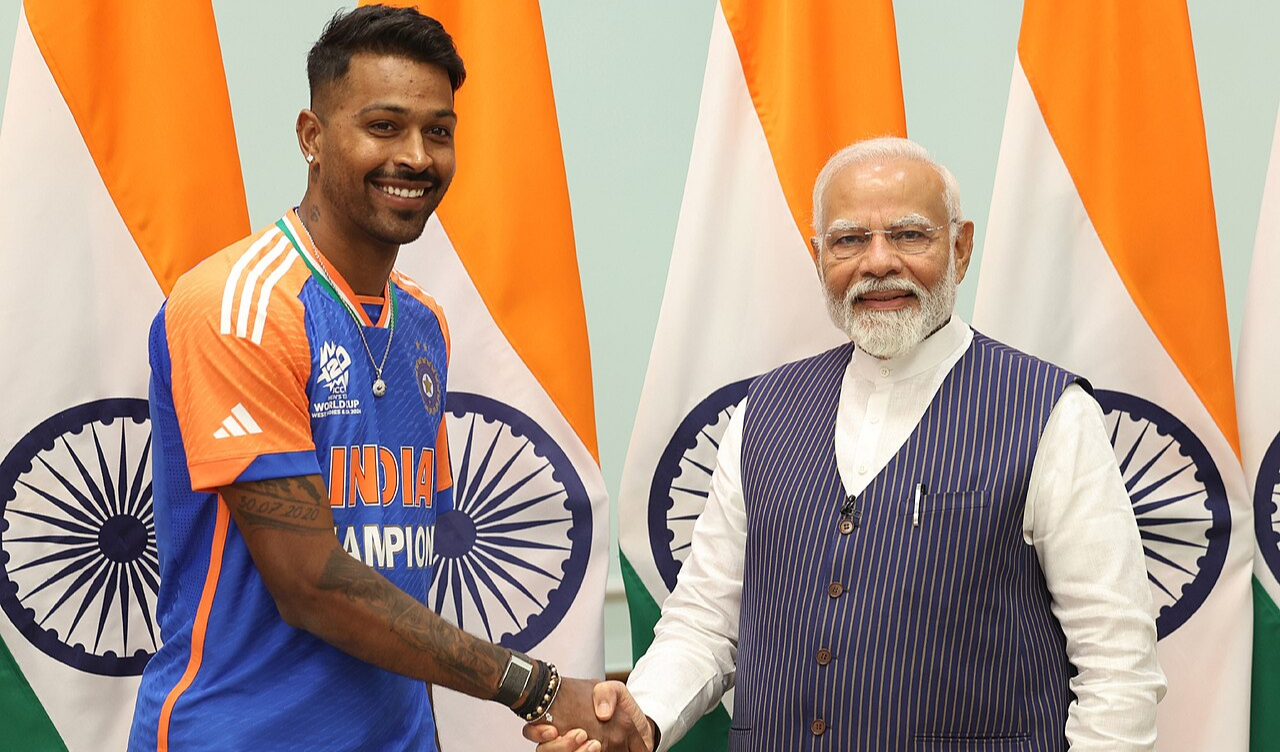
India A squads for the Australia A home series in Puducherry are out. Padikkal captains the multi-day team, Gaikwad leads the one-day side. India's Men's Selection Committee has picked the India A squads that will host Australia A in Puducherry, with Devdutt Padikkal set to lead the red-ball team and Ruturaj Gaikwad handed charge of the one-day side. The tour packs two multi-day matches and three one-day fixtures into a single venue. Play begins with the opening multi-day game from September 22 to 25, followed by the second from September 29 to October 2. The one-day matches are locked in for October 6, 9 and 11. Padikkal captains the multi-day squad, with Sai Sudharsan named as his vice-captain. The selectors handed places to batters Aman Mokhade, Ayush Pandey, Yash Rathod and Shaik Rasheed. Kumar Kushagra and N Jagadeesan provide the two wicketkeeping choices. The multi-day group also carries Shams Mulani, Tanush Kotian, Tushar Deshpande and Anshul Kamboj, alongside Praful Hinge, Nachiket Bhute and V Vyshak. Gaikwad takes over the captaincy for the one-day leg, and Padikkal drops down to serve as his deputy. That squad features Sai Sudharsan, Rajat Patidar, Priyansh Arya, Nishant Sindhu, Arshin Kulkarni and Naman Dhir. Hardik Pandya has been added to the one-day squad, though his inclusion depends on clearing a fitness check. Vyshak, who also appears in the multi-day list, faces the same fitness condition. The one-day group is rounded out by Vipraj Nigam, Arshad Khan, Prabhsimran Singh as a second wicketkeeper, Gurjapneet Singh and Yash Thakur. All five fixtures will be staged in Puducherry. Keywords: India A squad, Australia A series, Hardik Pandya, Ruturaj Gaikwad, Devdutt Padikkal, Puducherry cricket, India A vs Australia A, Sai Sudharsan  

BRICS Summit Opens in New Delhi With Modi-Xi Talks Set for Saturday

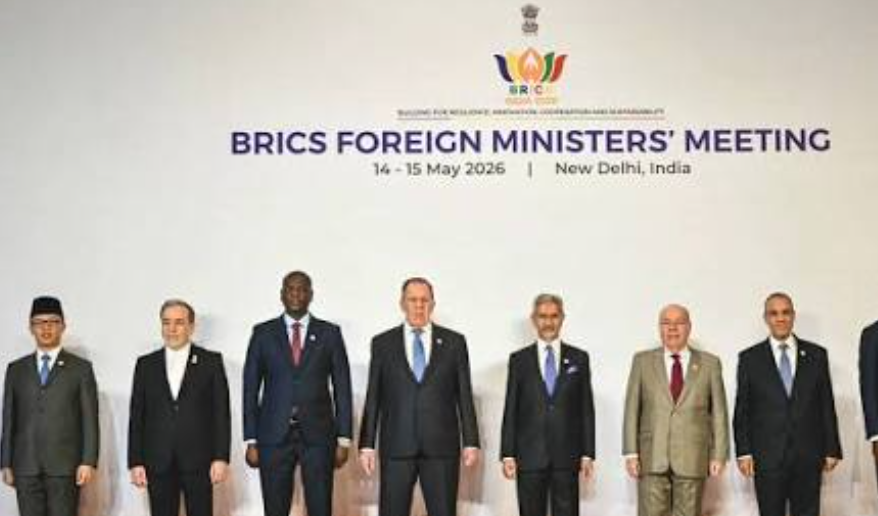
India hosts the 18th BRICS summit on Sept 12-13 at Bharat Mandapam, with Modi holding bilateral talks with Xi Jinping, Putin and Iran's Pezeshkian. India will host the 18th BRICS summit on September 12-13 at Bharat Mandapam in New Delhi, with Prime Minister Narendra Modi welcoming leaders of the bloc's member states and hosting a gala dinner on Saturday evening. The government confirmed the schedule in an announcement on Wednesday. The first day opens with Modi receiving the visiting leaders at the venue, followed by a closed-door session titled "Inclusive Global Governance and Strengthening Multilateralism." The gathering marks 20 years since the group was formalised. BRICS now counts 11 major emerging economies among its members. After the opening session, leaders will tour the Bharat Innovates exhibition at the venue. They will then assemble on the outdoor lawns for a family photograph and take part in a joint tree-planting. Modi is expected to hold a formal bilateral meeting with Chinese President Xi Jinping on Saturday, with both sides aiming to build on a recent improvement in relations. Xi last travelled to India in 2019 for the informal summit at Mamallapuram. As of Wednesday, Beijing had not yet officially confirmed his attendance. A separate bilateral meeting between Modi and Russian President Vladimir Putin is set for Friday. Modi is also expected to meet Iranian President Masoud Pezeshkian. The United Arab Emirates is likely to be represented by Abu Dhabi Crown Prince Sheikh Khaled bin Mohamed bin Zayed Al Nahyan. For India, the main challenge lies in reconciling differing positions on the situation in West Asia to reach a single, agreed BRICS declaration. On Sunday, the summit's second day, Modi will greet the leaders of the 10 BRICS partner countries and other invited guests. They will join a closing session titled "Resilience, Innovation, Cooperation and Sustainability: Shaping the Future for Inclusive Global Growth." Modi is expected to renew his push for a more inclusive and effective multilateral system as the world confronts mounting challenges. External Affairs Minister S Jaishankar has argued that BRICS must back a reformed multilateralism suited to present-day conditions, one in which bodies such as the United Nations, the WTO, the IMF and the World Bank become more representative. BRICS summit 2026, Narendra Modi, Xi Jinping India visit, Bharat Mandapam, India BRICS, Vladimir Putin, multilateralism, S Jaishankar

Debris in Basement, Wall Removed Before Delhi Collapse Killed 7

A probe into the Satya Niketan building collapse that killed seven found debris dumped in the basement and a ground-floor wall removed. An investigation into the building collapse in south-west Delhi's Satya Niketan has traced the disaster to two changes made during renovation work, officials said. The five-storey structure fell on Sunday, killing seven people, five of them students. Officials said renovation had been underway for more than a week before the collapse. Water had been pooling in the basement of the 50-year-old building, weakening it, and the owners decided to do away with the basement by filling it to the level of the ground floor. To do this, three truckloads of construction debris were dumped into the basement. At the same time, a wall on the ground floor was pulled down to open up more space for a shop. Investigators concluded that the extra weight in the basement, combined with the removal of the wall, badly undercut the building's stability and played a major role in bringing it down. Labour contractor Sanoj Kumar, who has been arrested, told police he was hired for the job by Mahesh Gupta, the son of one of the building's owners, Hariram Gupta. Kumar said he was paid Rs 2,800 a day. The First Information Report states that Hariram Gupta and his brother added extra floors to the ageing building even though they knew it was already weak. They had turned over its day-to-day operations to others, including Sudhanshu Gupta, who ran it as a paying guest accommodation branded 'Hostel Daze'. Rooms were rented mainly to students, drawn by the building's location close to Delhi University. On Wednesday, the Patiala House Court granted police two days' custody of Mahesh Gupta, contractor Sanoj Kumar and PG operator Sudhanshu. Delhi building collapse, Satya Niketan, Hostel Daze PG, Delhi University students, Mahesh Gupta, Delhi police FIR, Patiala House Court, building collapse investigation