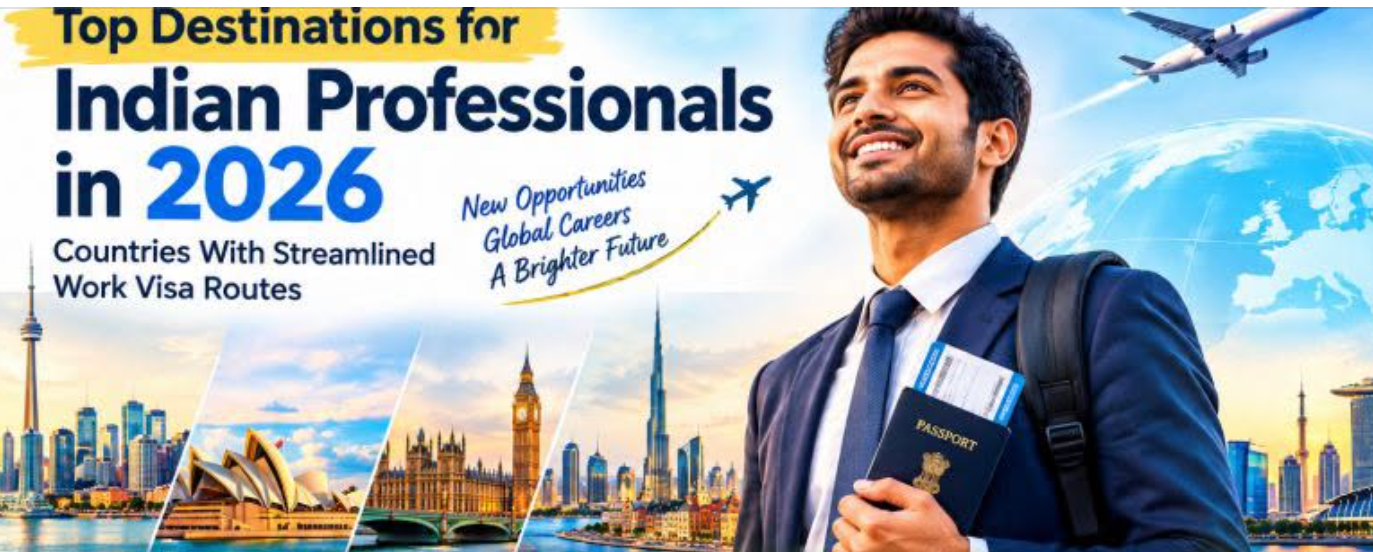
Indian professionals are exploring Mauritius, Mexico and Croatia for remote work, residency, lifestyle, taxation and European access.
Why More Indians Are Looking Beyond the US and Canada: Mauritius, Mexico and Croatia Emerge as Alternative Destinations
SPECIAL REPORT | GLOBAL MOBILITY, WORK & RESIDENCY
For Indian professionals seeking an international career, the traditional destinations of the United States, Canada, the United Kingdom and Australia are no longer the only options.
A growing number of internationally mobile Indians are examining countries that combine remote-work opportunities, residence pathways, relatively manageable living costs and access to international business markets.
Among the destinations attracting attention are Mauritius, Mexico and Croatia. Each offers a very different proposition.
Mauritius combines geographic proximity to India, a substantial population of Indian origin and a dedicated Premium Visa for people who want to live on the island while working remotely for an overseas business.
Mexico offers a temporary-residence system that can accommodate financially independent professionals and people earning income from outside the country.
Croatia, meanwhile, provides a European base through its digital-nomad temporary residence system and is already a member of both the European Union and the Schengen Area.
However, these options should not be confused with automatic citizenship programs. A residence permit generally allows a person to live in a country under specified conditions; it does not automatically provide citizenship or a new passport.
India's Overseas Migration Story
India has one of the world's largest international diasporas, and thousands of Indians relocate overseas every year for employment, education, business, family and other personal reasons.
Government data shows that the number of Indians formally renouncing Indian citizenship has increased substantially in recent years.
According to a July 2025 Rajya Sabha response, 2,06,378 Indians renounced Indian citizenship in 2024, compared with 2,16,219 in 2023 and 2,25,620 in 2022. The same government response recorded 1,63,370 renunciations in 2021 and 85,256 in 2020.
The figures are important, but they need to be interpreted carefully.
Renouncing Indian citizenship is not the same thing as moving abroad.
An Indian professional can live and work overseas while retaining Indian citizenship. Citizenship renunciation normally becomes relevant when an individual acquires foreign citizenship or voluntarily gives up Indian citizenship under the applicable law.
India's Citizenship Act provides for renunciation under Section 8, while the official Indian Citizenship Online portal provides a mechanism for submitting renunciation applications.
Therefore, claims that all Indians moving overseas are "surrendering their passports" would be inaccurate.
The more significant development is the expansion of the international mobility choices available to Indian professionals.
Why Professionals Are Looking Beyond Traditional Destinations
For many skilled workers, the decision to relocate is no longer simply about obtaining a job in another country.
Professionals increasingly consider several factors simultaneously:
-
Immigration processing requirements
-
Residence-permit duration
-
Remote-work compatibility
-
Income requirements
-
Housing costs
-
Internet connectivity
-
Healthcare
-
Personal safety
-
International flight connections
-
Tax residency
-
Family relocation
-
Business opportunities
-
Long-term residence possibilities
-
Education for children
-
Access to regional markets
This has created interest in countries that may offer a different combination of lifestyle and immigration requirements from the established migration destinations.
Three countries illustrate three different approaches: Mauritius, Mexico and Croatia.
1. Mauritius: An Indian-Friendly Island for Remote Professionals
Mauritius is geographically close to India and has deep historical, cultural and economic connections with the Indian subcontinent.
A significant proportion of Mauritius' population has Indian ancestry, while Indian languages, food, festivals and cultural traditions are visible throughout the country.
For Indian professionals, this can make cultural adjustment easier than in some distant destinations.
But culture is only one part of the equation.
Mauritius Premium Visa
Mauritius operates a Premium Visa specifically aimed at foreign nationals who want to stay for an extended period while working remotely.
According to the Mauritius Passport and Immigration Office, the Premium Visa permits eligible non-citizens to stay in Mauritius for one year, with the possibility of renewal.
Importantly, the official government page states that the Premium Visa is free of cost.
The program is designed for people such as:
The applicant must satisfy the applicable immigration requirements and demonstrate that the intended activities fit within the conditions of the visa.
Tax Considerations
Mauritius can also be attractive from a tax-planning perspective, but tax claims need to be treated carefully.
The Economic Development Board's Premium Visa guidance states that Mauritius-sourced income can be subject to taxation under a remittance-based approach. It also describes circumstances involving foreign credit or debit cards and money deposited into Mauritian bank accounts.
This does not mean that every remote worker automatically pays zero tax.
Tax liability can depend on:
-
Where the person is tax resident
-
Where employment is performed
-
Where income originates
-
Whether income is remitted
-
Double-taxation agreements
-
The structure of the person's business
-
The laws of the person's original country
Indian professionals should therefore obtain professional tax advice before relocating.
Mauritius and Indian Professionals
Mauritius offers several practical advantages for Indians:
Cultural familiarity
Indian-origin communities are well established, and Indian cultural traditions are widely represented.
Geographic proximity
Mauritius is significantly closer to India than North America, making family visits and business travel comparatively easier.
Remote-work environment
The Premium Visa specifically recognizes remote working arrangements.
International business environment
Mauritius has positioned itself as a financial and business-services centre serving African and international markets.
Lifestyle
The country combines an island environment with modern residential and commercial infrastructure.
For remote professionals who earn internationally, this combination can be particularly attractive.
2. Mexico: North American Lifestyle Without Moving to the United States
Mexico represents a completely different proposition.
Rather than serving as an alternative Asian or European-style destination, it provides access to a large North American economy, extensive cities, diverse climates and established international business networks.
Cities such as Mexico City, Guadalajara, Monterrey and Mérida attract international residents, entrepreneurs and remote professionals.
Mexico Temporary Resident Visa
Mexico's Temporary Resident Visa is available to foreign nationals who intend to remain in the country for more than 180 days and up to four years, subject to the applicable requirements.
The visa can be available through several qualifying routes, including financial solvency.
Mexico's official consular information also states that the temporary-residence framework can allow a foreigner to work in Mexico when the salary is paid from abroad. If the individual instead has employment in Mexico and receives salary domestically, additional authorization requirements apply.
That distinction is extremely important for remote workers.
Financial Requirements
Applicants applying through financial-solvency routes need to demonstrate sufficient financial resources.
The exact financial threshold can vary according to the applicable consulate, exchange rates and current rules.
For example, Mexico's official 2026 consular documentation specifies financial-solvency requirements based on bank balances or qualifying employment/pension income.
Therefore, applicants should check the requirements of the Mexican consulate where they will apply, rather than relying on an old blog or social-media post.
Mexico's Major Cities
Mexico City
One of Latin America's largest metropolitan areas, Mexico City provides:
-
International airports
-
Large technology and business communities
-
Restaurants and cultural institutions
-
Coworking spaces
-
Extensive public transportation
-
International schools and services
Guadalajara
Guadalajara has developed a major technology and startup ecosystem and is sometimes described as one of Mexico's leading technology centres.
Mérida
Mérida has attracted international residents looking for a smaller-city lifestyle, historic architecture and access to the Yucatán region.
Monterrey
Monterrey is one of Mexico's major industrial and business centres and has strong connections with manufacturing and corporate sectors.
Safety Requires Local Research
One claim that should not be generalized is that "Mexico is safe."
Mexico has substantial regional variation in crime and security conditions.
The experience of living in a particular neighbourhood can differ considerably from conditions elsewhere in the same metropolitan area or state.
Professionals considering Mexico should investigate:
A country-level safety label cannot adequately describe the conditions of every city.
Does Mexico Automatically Lead to a Powerful Passport?
No.
A temporary residence permit is not a passport.
Mexico has its own legal requirements for permanent residence and naturalization, and meeting the requirements for one status does not automatically guarantee another.
Professionals interested in eventual citizenship should study the current naturalization rules separately and maintain records of their legal residence.
3. Croatia: A European Base for Digital Nomads
Croatia offers a different proposition from Mauritius and Mexico.
It is an EU member state and has been part of the Schengen Area since January 1, 2023. It also uses the euro.
That makes Croatia particularly interesting to professionals who want to establish themselves in Europe while working remotely for a foreign employer or business.
Croatia's Digital Nomad Residence
Croatia officially recognizes digital nomads as third-country nationals who work using communication technology for a company or their own company that is not registered in Croatia, and who do not provide services to Croatian employers.
Temporary stay for digital nomads can be granted for up to 18 months, depending on the circumstances.
This provides a structured legal route for qualifying remote workers.
Income Requirement
Croatia has updated the financial requirements for digital nomads.
As of the current official guidance, applicants must demonstrate financial resources corresponding to at least 2.5 times the average monthly net salary used for the calculation.
The current stated minimum is €3,622.50 per month.
Alternatively, an applicant intending to stay for:
-
12 months can demonstrate €43,470 in available funds
-
18 months can demonstrate €65,205 in available funds
Additional amounts apply for qualifying family members.
These figures can change, so applicants should verify them immediately before applying.
Healthcare and Documentation
Croatia requires digital-nomad applicants to provide health insurance covering their stay.
Applicants also need documentation demonstrating the purpose of their stay, such as:
A criminal-record certificate may also be required for the initial application.
The Schengen Advantage
Croatia's membership of the Schengen Area is an important feature for internationally mobile residents.
However, a Croatian residence permit does not mean that the holder has unrestricted rights to live and work throughout the European Union.
Schengen primarily concerns movement across participating countries under applicable border rules.
EU freedom-of-movement rights are a separate legal matter and generally apply to EU citizens and qualifying categories of residents under specific legislation.
Therefore, a digital nomad should not interpret Croatian residence as an EU-wide work permit.
Mauritius vs Mexico vs Croatia
| Feature |
Mauritius |
Mexico |
Croatia |
| Main attraction |
Island lifestyle + remote work |
North American lifestyle |
European base |
| Remote-work pathway |
Premium Visa |
Temporary Residence |
Digital Nomad Residence |
| Maximum stated period |
1 year, renewable |
More than 180 days, up to 4 years |
Up to 18 months |
| Currency |
Mauritian rupee |
Mexican peso |
Euro |
| EU member |
No |
No |
Yes |
| Schengen member |
No |
No |
Yes |
| Cultural connection with India |
Strong |
More limited |
More limited |
| Overseas remote work |
Supported under applicable conditions |
Possible under qualifying arrangements |
Specifically recognized |
| Financial requirements |
Visa-specific |
Consulate-specific |
€3,622.50/month currently |
| Automatic citizenship |
No |
No |
No |
| Key consideration |
Tax/residency rules |
Local conditions and immigration rules |
EU/Schengen location |
The table highlights an important point: these countries are not interchangeable. Each addresses a different mobility objective.
The Passport Question: What Indians Need to Understand
The word "passport" is often used loosely in discussions about migration.
There are actually three different concepts:
1. Moving abroad
An Indian citizen can move overseas for employment, education or business while continuing to hold an Indian passport.
2. Obtaining residence
A foreign residence permit allows a person to live in another country under specified conditions.
It does not necessarily change citizenship.
3. Acquiring foreign citizenship
When an Indian citizen voluntarily acquires foreign citizenship, Indian citizenship is affected under the Citizenship Act.
The government states that an Indian citizen who voluntarily acquires citizenship of another country ceases to be an Indian citizen under Section 9 of the Citizenship Act.
The official Indian citizenship portal provides the procedure for renunciation and requires documents including the Indian passport, including expired passports.
This distinction is crucial for anyone considering international relocation.
Why Remote Work Is Changing International Migration
The traditional migration model was relatively straightforward:
Get a foreign job → obtain work visa → relocate → establish permanent residence.
The digital economy has created another pathway:
Earn internationally → work remotely → obtain residence permission → live abroad.
This model is particularly relevant to:
The ability to work through the internet has separated the location of the worker from the location of the employer.
But immigration law has not disappeared.
Remote workers still need to comply with:
Cost of Living: The Reality Behind the "Bengaluru Equivalent" Claim
It is tempting to say that a foreign country offers a European lifestyle for the same cost as Bengaluru or Gurugram.
That comparison can be misleading.
Living costs depend heavily on:
-
Rent
-
Neighbourhood
-
Family size
-
Schooling
-
Healthcare
-
Transportation
-
Dining
-
Insurance
-
Exchange rates
-
Travel frequency
-
Lifestyle
A single software professional working remotely can have a very different monthly budget from a family with two children.
The most useful comparison is therefore not simply:
"Country A is cheaper than Country B."
Instead, prospective migrants should calculate their personal monthly budget.
Example relocation budget
A professional should estimate:
Housing + utilities + internet + groceries + transportation + health insurance + visa costs + taxes + travel + emergency savings.
This produces a much more realistic picture than comparing average national living-cost figures.
Internet Connectivity Matters
For remote workers, reliable internet can be as important as rent.
Before choosing a city, professionals should check:
An inexpensive apartment is not necessarily suitable for a professional whose income depends on uninterrupted connectivity.
Family Relocation Requires a Different Calculation
A destination that works extremely well for a single professional may not be equally suitable for a family.
Families should investigate:
Education
-
International schools
-
Local schools
-
Tuition fees
-
Language requirements
Healthcare
-
Private hospitals
-
Health insurance
-
Specialist availability
-
Emergency services
Residence rights
Housing
These factors can significantly change the total cost of relocation.
Tax Residency Is One of the Biggest Issues
One of the most overlooked parts of international relocation is taxation.
Obtaining a visa does not automatically determine where an individual is tax resident.
A professional may potentially have tax obligations involving:
Double-taxation agreements can also affect the final tax position.
For Indian professionals, the interaction between Indian tax-residency rules, foreign residency and income earned abroad should be reviewed by a qualified tax professional before relocating.
Mauritius' own Premium Visa guidance, for example, specifically discusses how foreign employment income and remittances can be treated.
What Makes These Three Countries Different?
The attraction of these destinations lies in their different models.
Mauritius
Best understood as an island-based remote-work and long-stay option.
Its strongest differentiators include:
Mexico
Best understood as a large-country North American residence option.
Its differentiators include:
-
Large urban centres
-
North American location
-
Temporary residence of up to four years
-
Multiple qualifying routes
-
Established international communities
Croatia
Best understood as a European digital-nomad residence option.
Its differentiators include:
Important Warning Before Leaving India
Relocating overseas is a major financial and legal decision.
Professionals should not surrender an Indian passport simply because they are moving abroad.
Citizenship renunciation is a separate legal action.
Before taking that step, an individual should understand:
-
Whether foreign citizenship has already been obtained
-
Indian citizenship consequences
-
Passport surrender requirements
-
OCI eligibility
-
Tax residency
-
Indian property ownership
-
Bank accounts
-
Investments
-
Inheritance
-
Family citizenship
-
Overseas income
-
Business ownership
The Indian government has an online citizenship-renunciation system, and the competent authority verifies the passport and relevant details before issuing the renunciation certificate.
The New Geography of Indian Professional Migration
The international mobility landscape is becoming more diverse.
For decades, the conversation around Indian migration often centred on countries such as the United States, Canada, the United Kingdom and Australia.
Today, remote work and digital entrepreneurship have created additional possibilities.
Mauritius offers an Indian-connected island environment.
Mexico offers a large North American market and temporary-residence pathways.
Croatia offers a European location within the EU and Schengen Area.
None of these destinations is universally suitable.
The right choice depends on the individual's:
Most importantly, residence should not be confused with citizenship.
For Indian professionals exploring a global career, the bigger change is not simply the number of people leaving India. It is the growing number of legal and technological pathways allowing professionals to live in one country while earning from another.
That shift is creating a new form of international mobility—one driven not only by traditional employment migration, but also by remote work, entrepreneurship and location-independent careers.
News National Analysis | International Mobility & Global Careers