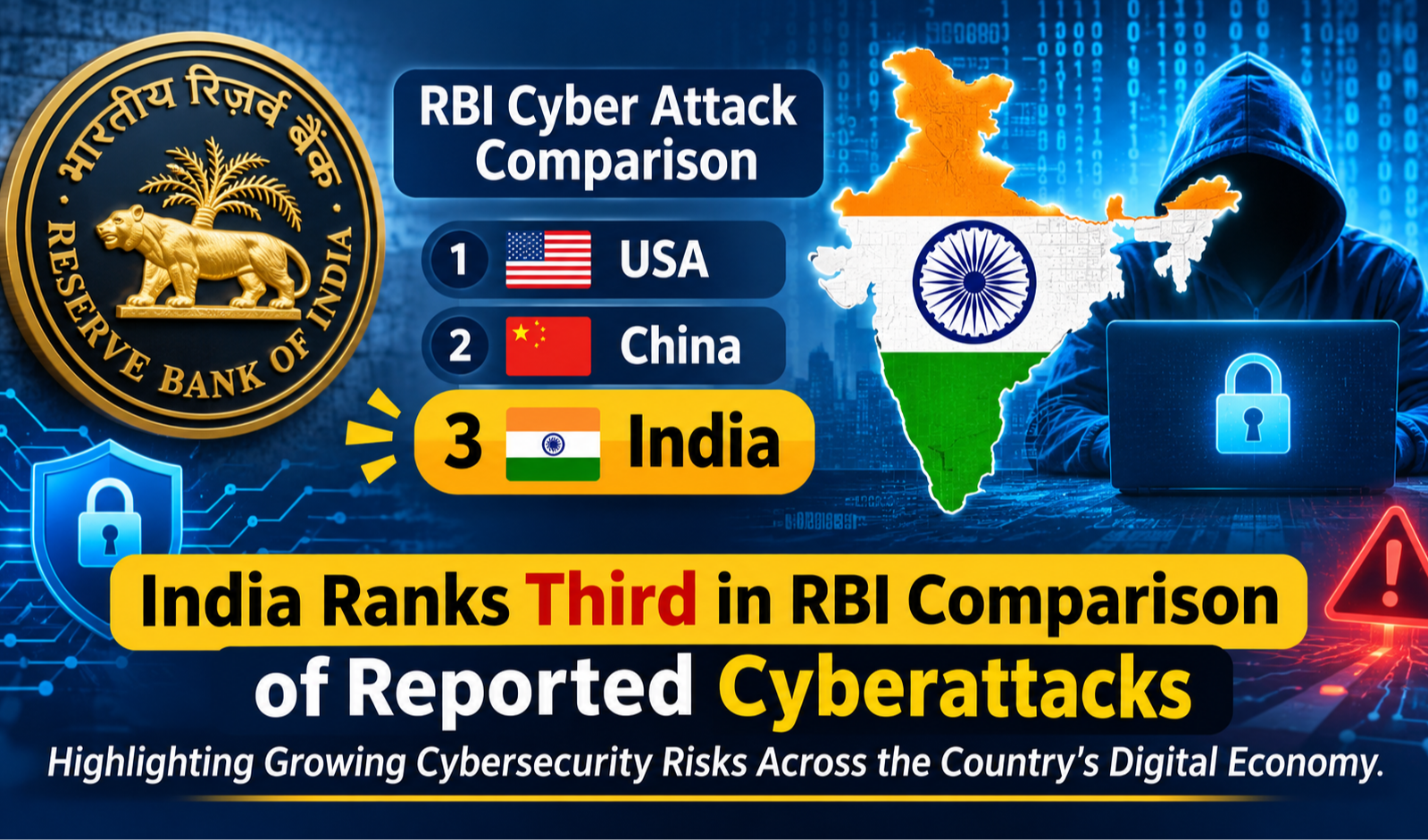
India ranks third in an RBI comparison of reported cyberattacks, highlighting growing cybersecurity risks across the country's digital economy.
By News National Editorial Team
India has ranked third among the emerging market economies featured in a Reserve Bank of India (RBI) comparison of publicly reported major cyberattacks, highlighting the growing cybersecurity challenges facing the country's rapidly expanding digital economy.
The comparison, included in the RBI's Financial Stability Report, June 2026, records 154 publicly reported material cyberattacks targeting India between January 2000 and May 2026. Russia recorded 256 incidents, while Ukraine recorded 159, placing India third in the displayed comparison.
The figures cover publicly reported material cyberattacks across sectors. They should not be interpreted as a count of every hacking attempt, unsuccessful intrusion, cybercrime complaint or security incident recorded by government agencies.
Russia, Ukraine and India Lead the Comparison
The country comparison presented in the supplied RBI-based graphic lists the following figures:
| Country |
Reported material cyberattacks |
| Russia |
256 |
| Ukraine |
159 |
| India |
154 |
| Turkey |
107 |
| China |
101 |
| Mexico |
64 |
| Philippines |
56 |
| Brazil |
56 |
| Vietnam |
54 |
| Thailand |
45 |
The comparison covers the period from 2000 to May 2026. It draws on publicly reported material cyberattack information, with the RBI report identifying the European Repository of Cyber Incidents (EuRepoC) and RBI staff estimates as its sources.
India's position in this comparison reflects the number of significant incidents documented in the underlying dataset. It does not establish that India has the third-highest number of all cyberattacks worldwide.
India's Cybersecurity Incidents Are Increasing
Separate government statistics demonstrate the scale of India's wider cybersecurity challenge.
According to information provided by the Ministry of Home Affairs in Parliament, the Indian Computer Emergency Response Team (CERT-In) recorded the following cybersecurity incidents:
-
2021: 14,02,809
-
2022: 13,91,457
-
2023: 15,92,917
-
2024: 20,41,360
-
2025: 29,44,248
The 2025 figure represents a substantial increase compared with the previous year.
However, these CERT-In figures measure cybersecurity incidents reported to and tracked by the national agency. They are not directly comparable with the RBI's historical dataset of publicly reported material cyberattacks.
CERT-In is India's national agency for responding to cybersecurity incidents under Section 70B of the Information Technology Act, 2000.
Why Is India Facing Growing Cybersecurity Risks?
India's digital economy has expanded rapidly through online banking, digital payments, e-commerce, cloud computing, government services and mobile applications.
This expansion has created opportunities for businesses and consumers, but it has also increased the number of systems and digital accounts that criminals may attempt to exploit.
Some of the important cybersecurity threats include:
1. Ransomware attacks
Ransomware can lock organisations out of their systems or encrypt critical information. Criminal groups may demand payment in exchange for restoring access or threaten to publish stolen data.
2. Phishing and financial fraud
Fraudsters use fake websites, emails, messages and telephone calls to trick individuals into revealing passwords, banking information, OTPs and other sensitive details.
3. Data breaches
Unauthorised access to databases can expose customer information, financial records, business documents and personal data.
4. Attacks against critical infrastructure
Cyber incidents involving electricity networks, telecommunications, transport systems, healthcare institutions and financial services could disrupt essential services.
5. Artificial intelligence-powered attacks
AI can help criminals create convincing fraudulent messages, automate reconnaissance and develop more sophisticated social-engineering campaigns. The RBI's June 2026 report identifies AI-enabled cyber threats as the leading perceived cybersecurity risk over the next 12 months among surveyed financial institutions.
RBI Warns About Cyber Risks to Financial Stability
The RBI's concerns extend beyond individual data breaches.
A serious cyber incident involving a bank, payment provider, technology supplier or financial market infrastructure could affect interconnected organisations.
The RBI's survey of major Indian banks and non-banking financial companies found that 79% of respondents conducted more than three-fourths of customer transactions digitally.
Although 98% of respondents assessed their current cyber risk levels as very low to moderate, the report identified areas requiring continued attention.
These include AI-enabled attacks, third-party technology dependencies, employee cybersecurity awareness, incident response and digital forensics.
The report also notes that 93% of surveyed institutions were partially or substantially dependent on external vendors for cybersecurity-related functions.
This makes technology supply-chain security an important consideration for the financial sector.
What Should Indian Businesses and Citizens Do?
Cybersecurity cannot be treated as the responsibility of technology companies alone. Businesses, government organisations and individual internet users all have a role to play.
Recommended precautions include:
-
Enable multi-factor authentication wherever available.
-
Use unique, strong passwords for important accounts.
-
Keep operating systems, applications and security software updated.
-
Avoid opening suspicious links and attachments.
-
Never disclose banking PINs, passwords or OTPs to callers or unknown websites.
-
Maintain regular, secure backups of important information.
-
Conduct periodic security audits and vulnerability assessments.
-
Train employees to identify phishing and social-engineering attacks.
-
Prepare an incident response plan and know how to report cyber incidents.
Organisations should also review the security arrangements of their cloud providers, software suppliers and other third-party technology partners.
India's Cybersecurity Challenge Requires Long-Term Investment
India's third-place position in the RBI's selected emerging-market comparison is an important warning about the country's exposure to significant cyber threats.
However, the ranking should be understood in its correct statistical context. Publicly documented major cyberattacks, CERT-In incident reports and attempted intrusions measure different aspects of cybersecurity.
The larger challenge is to strengthen digital infrastructure, improve threat detection, protect sensitive information and ensure that financial institutions and essential services can continue operating during cyber incidents.
As India's digital economy grows, cybersecurity will remain an important part of national economic security and public trust.
Sources and references:
-
Reserve Bank of India, Financial Stability Report, June 2026 – Box 1.1, Cyber Risk and Financial Stability.
-
Ministry of Home Affairs, Government of India – Parliamentary information on cybersecurity incidents, published 24 March 2026.
-
CERT-In, Government of India – National cybersecurity incident response and threat advisories.
-
Ministry of Electronics and Information Technology – Annual Report 2025–26, Internet Governance and Security of Cyberspace.
Editorial note: The country figures in this article reproduce the comparison in the supplied RBI-based infographic. They represent publicly reported material cyberattacks, not all cyberattacks or hacking attempts. The RBI comparison should not be presented as a global ranking of every country.
Disclaimer: This article is intended for general news and public awareness. Cyberattack counts depend on reporting, documentation and dataset methodology and should not be treated as a complete measurement of the actual number of cyber incidents in any country.