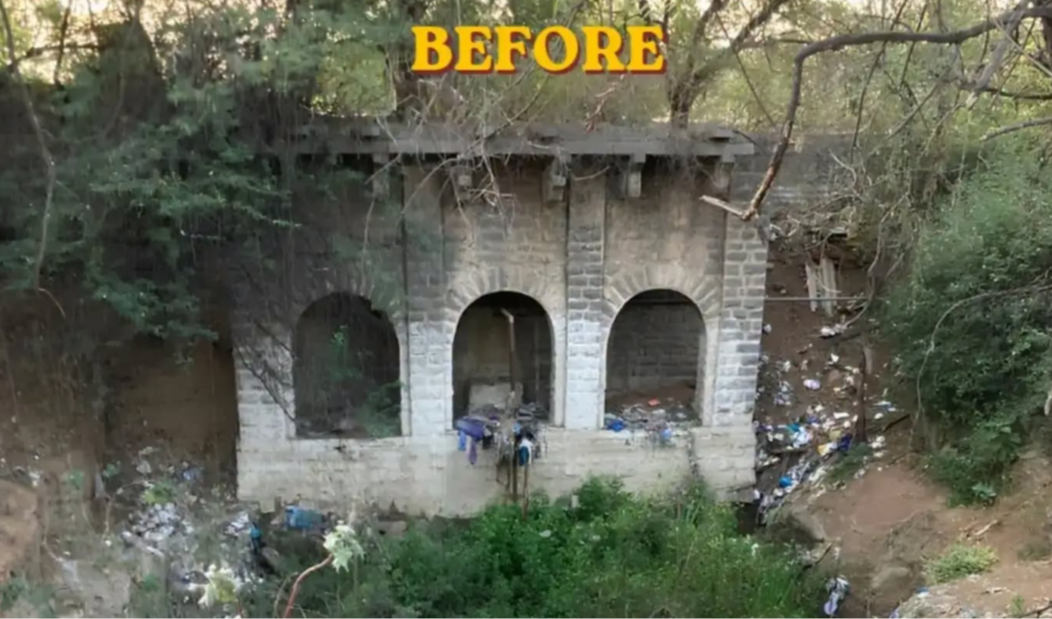
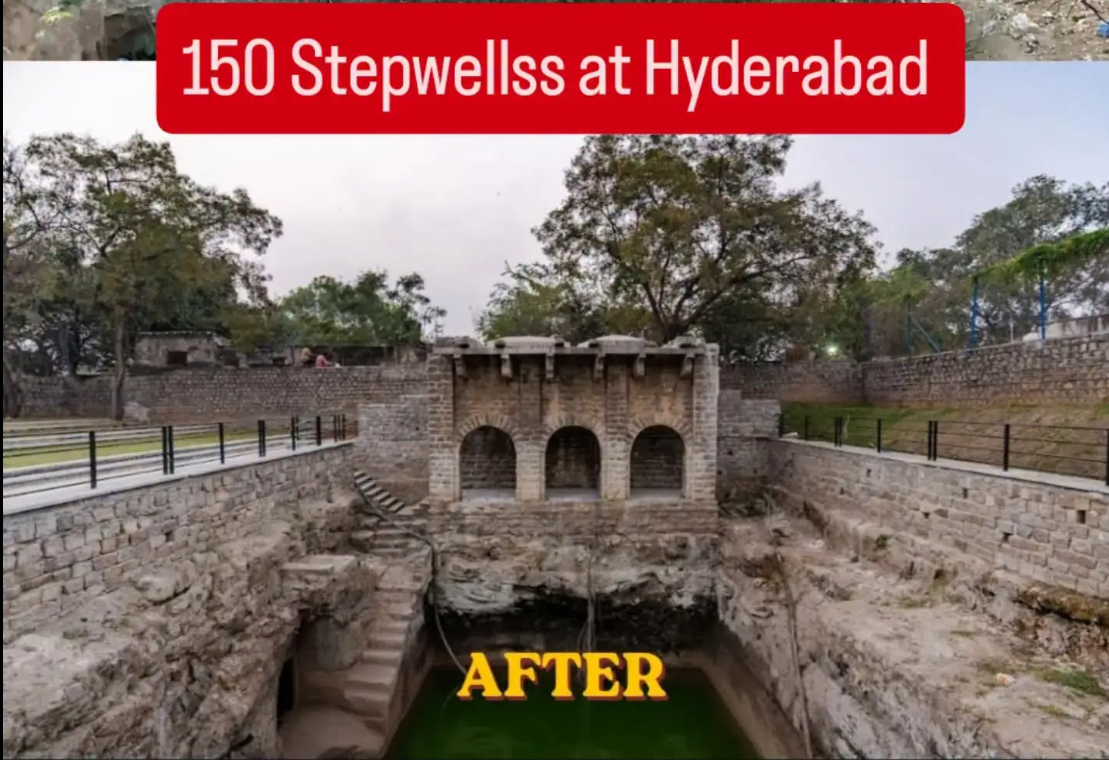
More than 150 stepwells have been mapped in Hyderabad, with 90% reportedly dilapidated. Can restoration support groundwater and water security?
Hyderabad’s Forgotten Stepwells: Can Restoring Ancient Water Systems Help Address the City’s Water Crisis?
By News National Editorial Team
HYDERABAD: As Hyderabad faces growing concerns over drinking water availability, declining groundwater levels and dependence on water tankers, attention is returning to an overlooked part of the city's heritage: its historic stepwells.
A mapping exercise by the Akarmaa Foundation has identified more than 150 stepwells within Hyderabad's Outer Ring Road limits. According to the foundation, around 90 per cent of the documented structures are in a dilapidated or derelict condition.
These traditional water structures, once used to access and store water, are now being considered for conservation as part of wider discussions about urban water management. Many require cleaning, structural repairs and protection from encroachment and neglect.
More than 150 stepwells identified
The Akarmaa Foundation has been documenting Hyderabad's historic stepwells and advocating their protection. Its co-founders, Arunima Shankar and Kaushik Kumar, have also been working with the Hyderabad Disaster Response and Asset Protection Agency (HYDRAA) on efforts to document and safeguard these structures.
In an interview with Hyderabad Mail published on October 27, 2026, Shankar said the foundation had mapped more than 150 stepwells within the Outer Ring Road region. She estimated that individual structures could hold between 25 lakh and one crore litres, depending on their size.
The foundation has argued that restoring these structures could help improve local water availability, support groundwater conservation and provide additional space for rainwater during heavy rainfall.
However, the estimated storage capacity of a stepwell should not be confused with the quantity of water it actually collects every year. Rainfall, catchment conditions, seepage, evaporation and maintenance all influence how much water remains available.
A water crisis brings heritage back into focus
Hyderabad's water concerns are linked to several factors, including population growth, urban expansion, rainfall variability, groundwater extraction and pressure on existing supply infrastructure.
A Deccan Chronicle report published on October 25, 2026, cited groundwater department data showing that Hyderabad's core urban region received 457 mm of rainfall against a normal 619 mm up to September 30, a deficit of 26 per cent. The report also noted that average groundwater depth in September was 11.58 metres below ground level, 6.85 metres deeper than a year earlier.
These figures underline the importance of improving water conservation and monitoring groundwater conditions.
Traditional stepwells could form one part of that effort, particularly when connected to suitable rainwater channels and maintained as functioning water structures.
Bansilalpet shows what restoration can achieve
The restored Bansilalpet Stepwell, also known as Nagannakunta, is one of Hyderabad's prominent examples of heritage conservation linked with water management.
According to The Rainwater Project's documentation, the stepwell has a stated holding capacity of more than 22 lakh litres and is associated with an estimated annual rainwater conservation figure of over 50 lakh litres.
A Deccan Chronicle report said the 63-foot-deep structure was being maintained with approximately 12 lakh litres of water at a level of around 35 feet. Some of the treated water is used for maintaining the site and, when required, supporting local community needs.
The example demonstrates how a restored historic structure can contribute to local water use and public awareness. It does not, however, establish that every stepwell can provide the same results or replace municipal water supplies.
Why restoration alone may not be enough
Water experts have cautioned against assuming that filling a stepwell automatically recharges groundwater.
Speaking to Deccan Chronicle, K. Venkateshwara Rao, joint director of the groundwater department, explained that traditional stepwells were primarily open wells built to provide water for domestic purposes. Whether water stored in a particular structure percolates into the surrounding aquifer depends on local geological and structural conditions.
The amount of water entering a stepwell, the rate of seepage, the condition of its base and the surrounding soil all need to be studied.
Conservationist Kalpana Ramesh, founder of The Rainwater Project, also emphasised that storage capacity alone cannot determine a stepwell's usefulness. Actual rainfall inflows, seasonal water levels and the duration for which water remains available must be measured.
Scientific monitoring would therefore be essential before estimating the contribution of restored stepwells to Hyderabad's overall water supply.
Can stepwells address 50 per cent of Hyderabad's water demand?
The Akarmaa Foundation has suggested that restoring and protecting Hyderabad's stepwells could potentially address up to 50 per cent of the city's water demand in the long term.
This is an ambitious projection made by the organisation, not an independently established water-supply estimate. The groundwater department has highlighted the need for systematic measurements to determine actual recharge and water availability.
A realistic assessment would require information on the quantity of rainwater entering each structure, annual storage, water quality, groundwater-level changes and the number of people or public facilities benefiting from the restored sites.
What Hyderabad needs next
Conservationists and urban planners have several practical priorities to consider:
-
Complete a verified inventory of historic stepwells and assess their structural condition.
-
Remove accumulated garbage and debris through scientifically supervised restoration.
-
Protect catchment areas and reconnect suitable rainwater channels.
-
Test water quality before allowing any public use.
-
Monitor groundwater levels around restored sites over multiple seasons.
-
Establish clear responsibility for maintenance, safety and community participation.
-
Coordinate heritage conservation with municipal water and urban flood-management planning.
News National Perspective
Hyderabad's stepwells are more than architectural reminders of an earlier era. They represent traditional approaches to accessing and managing water that may still have a role in modern urban planning.
Restoring them will not independently resolve the city's water crisis. But protecting these structures, reconnecting appropriate rainwater channels and measuring their actual contribution could strengthen local conservation efforts.
The challenge for Hyderabad is to treat water heritage as part of a broader, scientifically planned strategy involving reservoirs, groundwater management, rainwater harvesting, wastewater reuse and responsible consumption.
The city's historic stepwells may not be a complete answer to future shortages, but allowing them to disappear without proper assessment would mean losing potentially valuable infrastructure and an important part of its heritage.
Sources and fact-check notes
-
Deccan Chronicle – Stepwells Offer Partial Relief to Water Crisis (October 25, 2026). The main source for the 150-plus mapped structures, estimated 90% dilapidation, rainfall deficit, groundwater observations and expert cautions.
-
Hyderabad Mail – Mee Baavi: Reviving Hyderabad’s Ancient Stepwells for Water Security (October 27, 2026). Interview with Akarmaa co-founder Arunima Shankar, including the foundation's estimates and its proposed conservation initiative.
-
The Rainwater Project – Bansilalpet Stepwell. Project documentation on restoration, stated holding capacity and estimated annual rainwater conservation.
-