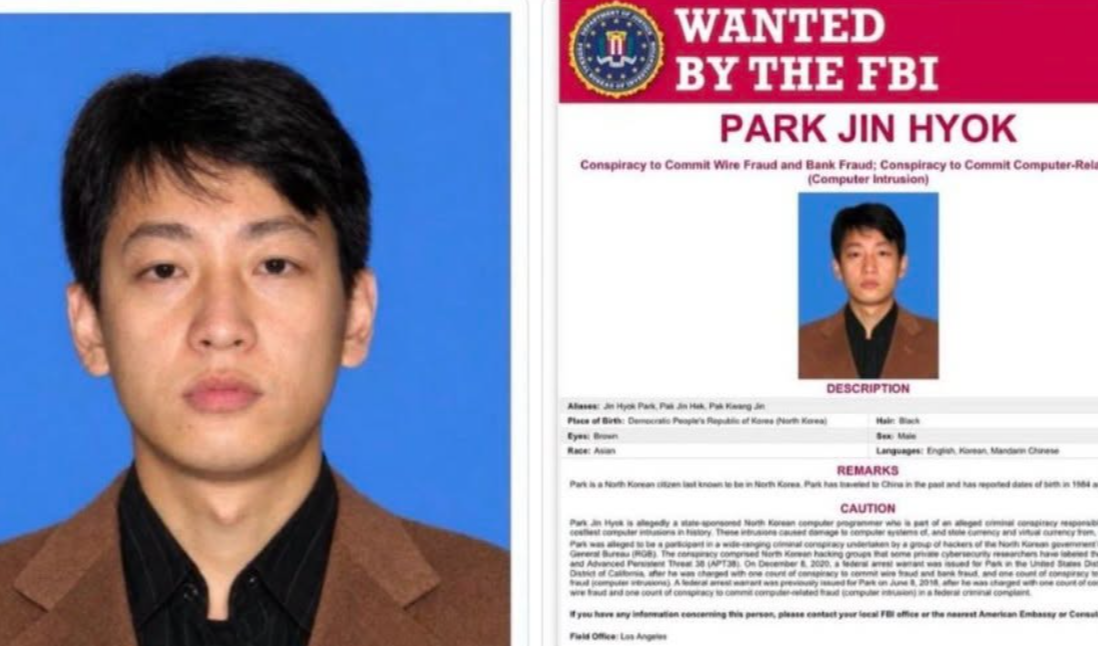
FBI wanted North Korean programmer Park Jin Hyok was charged over alleged links to the Sony hack, Bangladesh Bank theft and WannaCry.
FBI Wanted North Korean Programmer Linked to Sony Hack, $81 Million Bangladesh Bank Heist and WannaCry Attack
By News National Editorial Team
A North Korean computer programmer wanted by the Federal Bureau of Investigation (FBI) has been linked by US authorities to several major cyberattacks that affected businesses, financial institutions and computer systems worldwide.
The individual, identified as Park Jin Hyok, also known as Pak Jin Hek and Jin Hyok Park, was accused of participating in a state-sponsored hacking conspiracy associated with North Korea's intelligence apparatus.
US investigators have connected the alleged conspiracy to the 2014 Sony Pictures cyberattack, the 2016 Bangladesh Bank cyber theft and the 2017 WannaCry ransomware outbreak.
The case illustrates how cybercrime can extend beyond individual financial fraud to attacks affecting governments, hospitals, entertainment companies and international financial systems.
Who Is Park Jin Hyok?
According to the US Department of Justice, Park Jin Hyok was a North Korean computer programmer who allegedly worked for Chosun Expo Joint Venture, also known as Korea Expo Joint Venture.
US investigators alleged that the organisation functioned as a front company supporting North Korean government cyber operations.
Authorities linked Park to a hacking operation known in the cybersecurity industry as the Lazarus Group.
The FBI identifies Park as a wanted individual facing conspiracy charges involving wire fraud, bank fraud and computer-related fraud.
The FBI's wanted notice states that his last known location was North Korea.
1. Sony Pictures Cyberattack – 2014
One of the most prominent incidents associated with the alleged conspiracy was the November 2014 cyberattack against Sony Pictures Entertainment.
The attack compromised the company's computer networks and exposed sensitive corporate information.
Stolen information included:
-
Confidential corporate emails.
-
Employee personal information.
-
Internal business documents.
-
Unreleased films and other entertainment content.
-
Sensitive company communications.
The incident disrupted Sony Pictures' operations and created significant financial and reputational damage.
US authorities attributed the operation to North Korean hackers and linked Park to the alleged conspiracy.
2. Bangladesh Bank Heist – 2016
In February 2016, hackers targeted Bangladesh Bank, the country's central bank, using fraudulent international payment instructions through the SWIFT financial messaging system.
The attackers attempted to transfer nearly $1 billion from the bank's account at the Federal Reserve Bank of New York.
Approximately $81 million was successfully transferred to accounts in the Philippines before the operation was stopped.
Investigators linked the cyber theft to the North Korean hacking operation and accused Park of participating in the wider conspiracy.
The incident exposed weaknesses in international banking security and demonstrated how cybercriminals could exploit financial messaging systems to target large institutions.
3. WannaCry Ransomware – 2017
In May 2017, WannaCry ransomware spread rapidly across computer networks in numerous countries.
The malware encrypted files on infected computers and demanded ransom payments in Bitcoin.
The attack affected hundreds of thousands of computers across more than 150 countries, according to widely cited cybersecurity estimates.
One of the most significant victims was Britain's National Health Service (NHS).
Hospitals and healthcare facilities experienced major disruptions, including cancelled appointments and interrupted services.
The US Department of Justice subsequently linked the creation of the WannaCry 2.0 malware to the alleged North Korean hacking conspiracy involving Park.
The incident became a major international warning about the risks of outdated software, unpatched security vulnerabilities and interconnected computer networks.
4. The $1.3 Billion Cybercrime Conspiracy
On February 17, 2021, the US Department of Justice announced charges against three North Korean computer programmers.
The defendants were:
-
Park Jin Hyok.
-
Jon Chang Hyok.
-
Kim Il.
The indictment alleged that the three participated in a wide-ranging conspiracy involving cyberattacks, financial theft, cryptocurrency theft and extortion.
According to prosecutors, the alleged conspiracy attempted to steal or extort more than $1.3 billion in money and cryptocurrency from financial institutions and businesses worldwide.
The indictment also described attacks against banks, cryptocurrency companies and other commercial organisations.
Important distinction: The $1.3 billion figure represents attempted and successful thefts and extortion combined. It does not mean that $1.3 billion was successfully stolen by Park personally.
5. Why US Authorities Consider the Case a National Security Concern
The US government has alleged that North Korean cyber operations serve both financial and strategic objectives.
According to the Department of Justice, the alleged operations were connected to North Korean military intelligence structures, including the Reconnaissance General Bureau.
Authorities have argued that cyber operations can generate money for the North Korean government while also enabling espionage, disruption and other strategic activities.
The case highlights the growing role of cyber capabilities in international security.
6. Is Park Jin Hyok Still Wanted by the FBI?
Yes. The FBI's official wanted page continues to list Park Jin Hyok.
According to the FBI:
-
He is a North Korean citizen.
-
His last known location was North Korea.
-
A US federal arrest warrant was issued on June 8, 2018.
-
A further federal arrest warrant was issued on December 8, 2020, following additional charges.
The FBI wanted notice lists aliases including Jin Hyok Park, Pak Jin Hek and Pak Kwang Jin.
The case remains an example of the difficulties international law enforcement agencies face when suspects are believed to be residing in countries outside their practical reach.
There is an important distinction between a US federal arrest warrant and an international arrest warrant. The official FBI record establishes the former; it does not establish that a new Interpol Red Notice has been issued.
7. What Businesses and Internet Users Can Learn
The cyberattacks associated with the case demonstrate why cybersecurity is essential for organisations of every size.
Businesses should strengthen their security practices through:
-
Regular operating system and software updates.
-
Multi-factor authentication.
-
Secure backup systems.
-
Employee cybersecurity training.
-
Network monitoring and incident response.
-
Protection of banking and financial accounts.
-
Regular vulnerability assessments.
Hospitals, financial institutions, government organisations and technology companies should maintain tested cybersecurity and recovery plans.
Even small businesses can become targets when their systems contain valuable information or provide access to larger networks.
Conclusion
The case of Park Jin Hyok illustrates the international reach of alleged state-sponsored cybercrime.
From the Sony Pictures attack to the Bangladesh Bank theft and WannaCry ransomware outbreak, US authorities have connected the North Korean programmer to a series of significant cyber operations.
Although the FBI continues to list him as wanted, the allegations should not be confused with a conviction.
The case also demonstrates why cybersecurity is no longer just a technical concern. It is an important issue affecting financial stability, public services, international relations and national security.